An Atlas of Money · All entries
Brass rods on the middle Congo
Attested Little disputed
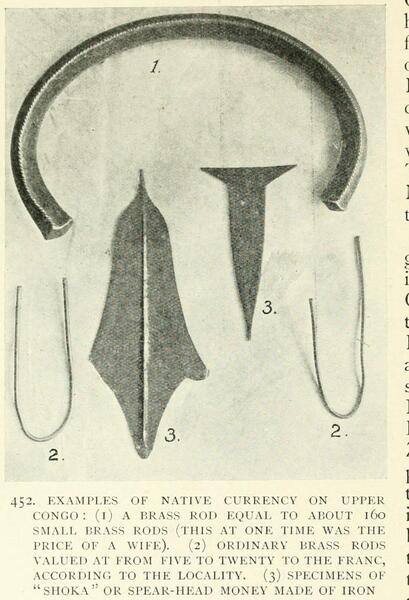
Open on the mapJohnston (1908) states that along the Congo east to Stanley Falls the unit of value was the ntaku or brass rod, cut from imported wire; Grenfell's journal records that c. 1849 one rod bought ten cakes of manioc at Stanley Pool, but by 1889 a cake cost fifteen rods.
No state involved
No one's debt

Claims and evidence
Johnston (1908) states that along the Congo east to Stanley Falls the unit of value was the ntaku or brass rod, cut from imported wire; Grenfell's journal records that c. 1849 one rod bought ten cakes of manioc at Stanley Pool, but by 1889 a cake cost fifteen rods. Attested Little disputed
“the unit of value was the ntaku or brass rod”
Johnston, H. H., George Grenfell and the Congo, vol. 2 (1908), pp. 795-796 ('Trade and currency')
Casement (1903) reports brass rods as the recognized currency of most of the Upper Congo, nominally a halfpenny, twenty to the franc, though a rod had shrunk from 18 inches to 8 or 9 and cost an importer less; European money was still unknown there. Attested Little disputed
“In most parts of the Upper Congo the recognized currency consists of lengths of brass wire; these lengths varying according to the district. At one; period the recognized length of a brass rod was 18 inches, but to-day the average length of a rod cannot be more than 8 ot 9 inches. The nominal value of one of these rods is 1/2d. twenty of them being reckoned to the franc ; but the intrinsic value, or actual cost of a rod to any importer of the brass wire direct from Europe, would come to less than a 1/2d. I should say. Such as it is, clumsy and dirty, this is the principal form of currency known on the Upper Congo where, saving some parts of the French Congo I visited, European money is still quite unknown.”
Casement, R., Report on the Administration of the Independent State of the Congo (1904), Report, Upper Congo section (F* villages)