An Atlas of Money · All entries
Lysimachos and the posthumous west-Pontic staters
Supported Little disputed
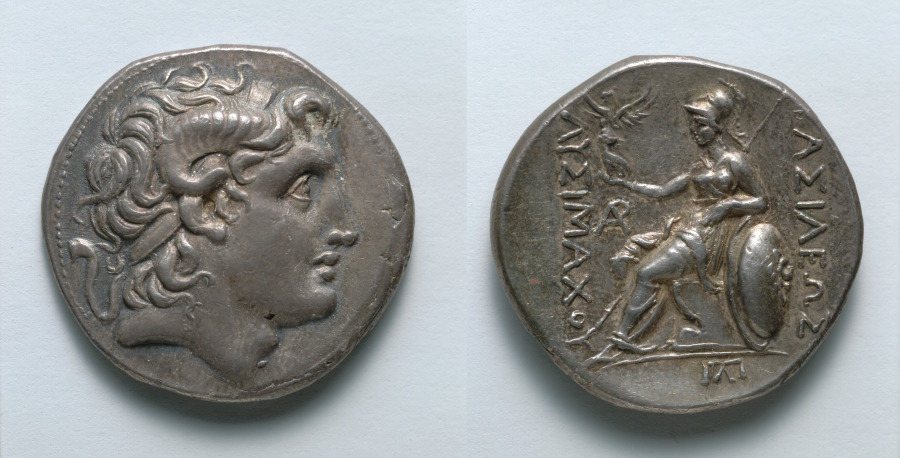
Open on the mapLysimachos, king of Thrace, struck gold staters and silver tetradrachms with a portrait of the deified Alexander. West Pontic cities went on striking coins of his type for centuries as a trade and military currency.
State-issued
No one's debt
Claims and evidence
Lysimachos (c. 306–281 BC) struck gold staters (Athena / Nike) and silver tetradrachms with the deified Alexander wearing the horn of Ammon; 'posthumous Lysimachi' were struck for centuries by west-Pontic cities as an international trade currency. Supported Little disputed
- Corpus Nummorum type 12246 (Sestos mint tetradrachm); Thompson (1968); Müller (1858); HGC 3
The west-Pontic coast kept striking posthumous Alexander tetradrachms and Lysimachus staters into the 1st c. BC; Petac dates the start to the mid-3rd c. BC (Mesambria c. 250 BC, Istros switch c. 215 BC) while de Callataÿ puts the late mass issues in the Mithridatic horizon as tribute and mercenary money (c. 110–72 BC); the two largely complement each other. Supported Disputed
Contested by de Callataÿ (1994; 1995; 2012): late mass issues as Mithridatic military money, against Petac's earlier dating of the series
- Petac, AJN 23 (2011), 7–14; Petac (2010)
- de Callataÿ, 3e Symposium Cabyle (1994); Dobrudja 12 (1995)
The sources do not say where Lysimachos' revenues came from; the view that they came mainly from squeezing the Greek cities lacks proof, a full grain-trade monopoly is unrealistic, but control of Thracian grain export from the coastal cities seems 'quite certain'. Supported Disputed
Contested by Franco (1993), as relayed by Delev: a full Lysimachean monopoly of the grain trade between the Pontus and the Aegean
- Delev, Лизимах (2004), pp. 357, 362–363