An Atlas of Money · All entries
Bombay: the company's 'Rupee of Bombaim'
Attested Little disputed
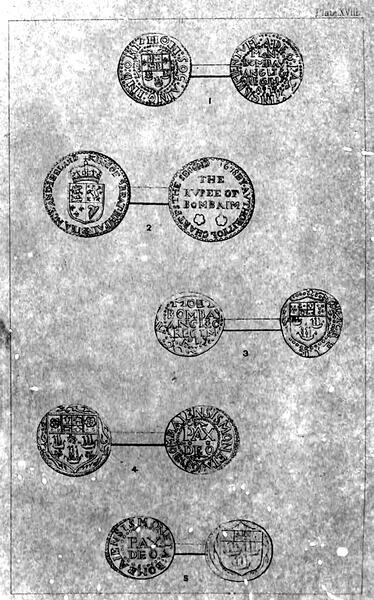
Open on the mapA charter of Charles II (1677) let the East India Company coin money at Bombay as 'Rupees, Pices, and Budgrooks'. Its first rupee, dated 1677, reads 'by authority of Charles the Second'.
Private, under state licence or control
No one's debt
Claims and evidence
A charter of Charles II (1677) gave the East India Company power to coin money of gold, silver, copper, tin or lead at Bombay, to be called 'Rupees, Pices, and Budgrooks'. Attested Little disputed
“to ftamp and coin, or cauJe to be ftamped and coined. Monies of Gold, Silver, Copper, Tin or Lead, or of any mixt Metal compounded or made up of them”
Charters granted to the East-India Company, from 1601 (London, 1773): charter of Charles II, 28th regnal year (dated 1677 in the heading), charter of 1677, coinage clause“or Names of Rupees, Pices, and Budgrooks”
Charters granted to the East-India Company (1773), charter of 1677, charter of 1677, coinage clause
The company's first Bombay rupee, of 1677, reads 'The Rupee of Bombaim … by authority of Charles the Second'; Chalmers gives its weight as 167.8 grains. The directors had ordered a mint on the island in 1671. Attested Little disputed
“In centre THE RVPEE. OF BOMBAIM With rosettes ; around BY. AVTHORITY. OF CHARLES. THE. SECOND. 1677.”
Thurston (1890), catalogue: Silver Rupee A.D. 1677, catalogue, Bombay no. 2“"Rupee of Bombaim " of 1677, weighing 167*8 grs.”
Chalmers (1893), ch. XXXIV, India, p. 336“Accordingly in 1671 the Court of Directors gave instructions to their servants at Bombay to establish a mint upon the island”
Thurston, E., History of the Coinage of the Territories of the East India Company in the Indian Peninsula (Madras, 1890), p. 16
In 1693 the company had to explain to the Mughal court why it coined money in its own king's name. Supported Little disputed
“they explained their-coining money in their own king's name (which was another complaint against them) by stating that they had to purchase investments at places, where the Moghtl's money did not pass.”
Thurston (1890), quoting Elphinstone, History of India, on 1693, p. 25