An Atlas of Money · All entries
Card money of New France
Attested Little disputed
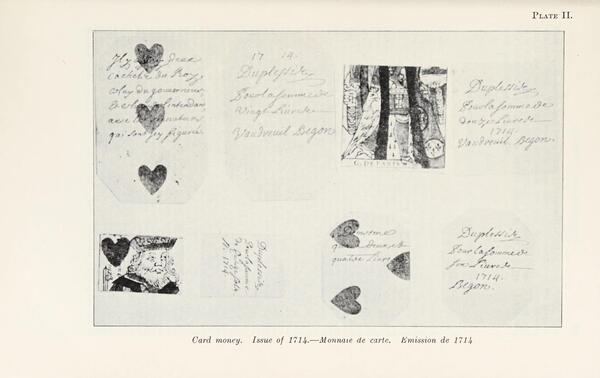
Open on the mapIn 1685 the intendant De Meulles, lacking coin to pay the troops, issued playing cards cut in quarters as notes, made them compulsory in payment and pledged to redeem them. Card issues recurred until the Crown converted the outstanding cards at half their face value (1714-1717) and declared unreturned cards worthless.
State-issued
A claim on an issuer
Claims and evidence
In 1685 the intendant De Meulles, lacking coin to pay the troops, issued notes on playing cards cut in quarters and obliged all inhabitants by ordinance to accept them, pledging to redeem them. Attested Little disputed
“it occurred to me to issue, instead of money, notes on cards, which I have had cut in quarters.”
Shortt (ed.), Documents relating to Canadian currency, exchange and finance during the French period, vol. 1 (Public Archives of Canada, 1925), vol. 1, De Meulles to the Minister, 24 Sept. 1685, pp. 73-75“I have issued an ordinance by which I have obliged all the inhabitants to receive this money in payments, and to give it circulation, at the same time pledging myself, in my own name, to redeem the said notes.”
Shortt (ed.), Documents relating to Canadian currency, exchange and finance during the French period, vol. 1 (Public Archives of Canada, 1925), vol. 1, De Meulles to the Minister, 24 Sept. 1685
The Crown later converted the cards into bills of exchange at half their face value and declared unreturned cards worthless. Supported Little disputed
“The cards were to be converted into bills of exchange at one-half their face value”
Shortt (ed.), Documents relating to Canadian currency, exchange and finance during the French period, vol. 1 (Public Archives of Canada, 1925), editor's introduction, p. lxii (decision of 23 May 1714)“All card money not returned then was declared worthless from the date of the declaration.”
Shortt (ed.), Documents relating to Canadian currency, exchange and finance during the French period, vol. 1 (Public Archives of Canada, 1925), editor's introduction, p. lxiii (Declaration of the King, 5 July 1717)
In 1703 Governor Brouillan followed the Canadian example and paid for fortification work at Port Royal in card money; the Minister disapproved, and by December 1708 the cards were withdrawn against the treasurer's notes, in a colony with no coin in circulation. Attested Little disputed
“this obliges me to follow the example of Canada, in making use of card money, without which I would not have been in a position to have the work carried on.”
Shortt (ed.), Documents relating to Canadian currency, exchange and finance during the French period, vol. 1 (Public Archives of Canada, 1925), vol. 1, Brouillan to the Minister, Port Royal, 25 Nov. 1703, p. 125“It IS nearly two years since the circulation of card money ceased in this country”
Shortt (ed.), Documents relating to Canadian currency, exchange and finance during the French period, vol. 1 (Public Archives of Canada, 1925), vol. 1, "Necessity for Card Money in Acadia", 22 Dec. 1706, p. 161“The card money is all withdrawn, for the value of which I have given my notes to individuals. As there is no coined money in this country, these individuals are continually bringing these notes back to me, to be broken up into numerous sums, for the requirements of their business”
Shortt (ed.), Documents relating to Canadian currency, exchange and finance during the French period, vol. 1 (Public Archives of Canada, 1925), vol. 1, de Goutin, Port Royal, 29 Dec. 1708, p. 189