An Atlas of Money · All entries
Carthage begins to coin
Supported Little disputed
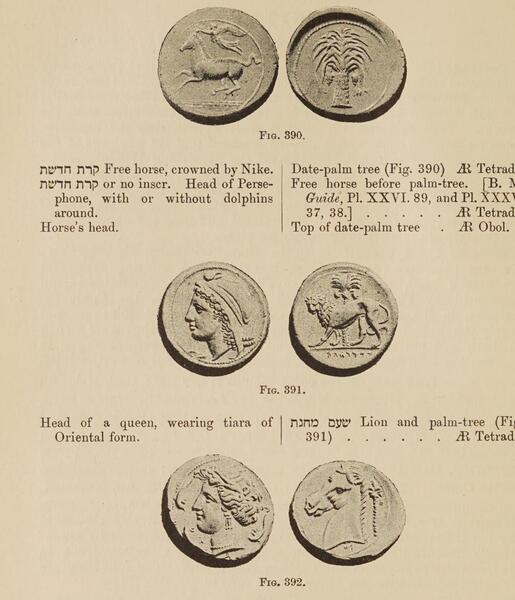
Open on the mapHead says Carthage made no use of coin until the invasion of Sicily in 410 BC. It then struck Greek-style pieces in Sicily to pay its troops, and later gold, electrum and bronze at Carthage itself. Its money declined in style and in quality of metal down to 146 BC.
State-issued
No one's debt
Claims and evidence
Head says Carthage made no use of coin until the invasion of Sicily in 410 BC. It then struck Greek-style pieces in Sicily to pay its troops, and later gold, electrum and bronze at Carthage itself. Its money declined in style and in quality of metal down to 146 BC. Supported Little disputed
“made no use whatever of coined money until the great invasion of Sicily, B.C. 410”
Head, Historia Numorum, 2nd ed. (1911), Zeugitana: Carthago, p. 877“as coins struck in Sicily for the payment of the Carthaginian armies”
Head, Historia Numorum, 2nd ed. (1911), p. 878“The money struck at Carthage itself consists wholly of gold (seldom pure), electrum, and bronze”
Head, Historia Numorum, 2nd ed. (1911), p. 879“remarkable for a rapid degradation in the style of its execution, and in the quality of the metal employed.”
Head, Historia Numorum, 2nd ed. (1911), Introduction, general survey of the period to 146 BC
The pseudo-Platonic Eryxias says the Carthaginians used as money a sealed piece of leather wrapped round something the size of a stater, worthless outside Carthage. Weak lead Little disputed
“Something which is about the size of a stater is tied up in a small piece of leather: what it is, no one knows but the makers. A seal is next set upon the leather, which then passes into circulation”
[Pseudo-]Plato, Eryxias, tr. Jowett, Gutenberg #1681 (archive.org mirror), Eryxias 399e-400a (Jowett)“the Carthaginian coinage is not wealth in our eyes, for we could not employ it, as we can silver, to procure what we need”
[Pseudo-]Plato, Eryxias, tr. Jowett, Gutenberg #1681 (archive.org mirror), Eryxias 400b approx.