Money in Georgia
Entries placed by today's borders.
Entries 6, in 3 eras
Span 400 BC – 1994
Kinds of money Gold coin 2, Silver coin 1, Base-metal coin 1, State notes 1, Tsarist rouble notes 1
W ithin present-day Georgia, the atlas places 6 entries, by their main place or a dated one, from 400 BC to 1994. The oldest is Colchis, c. 400 BC or later: small base-silver coins found in Mingrelia (400 BC–300 BC); the most recent, Hyperinflation: Georgia (Coupon) (1993–1994). The money named most often is Gold coin, in 2 entries.
Antiquity 3000 BC – AD 499
1 entry, 400 BC–300 BC
The coins usually attributed to this region are small pieces of base silver weighing about 36 grs.Head, B. V., Historia Numorum: A Manual of Greek Numismatics, new ed. (Oxford, 1911), p. 495, Colchis
List of entries (1)
Middle period 500–1499
1 entry, 1187–1210
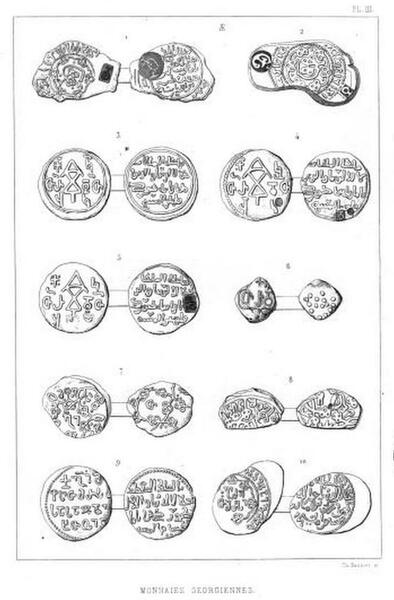
List of entries (1)
- 1 Queen Tamar's copper coins 1187–1210
Modern 1900 to today
4 entries, 1918–1994

the Turkish lira and Russian gold and silver ceinage of the pre-revolutionary mintage.L. N. Yurovsky, Currency Problems and Policy of the Soviet Union (London: Leonard Parsons, 1925), p. 57
What served as money share of 4 mentions
Hollow marks: entries elsewhere that share this era's money (Tsarist rouble notes); the 3 farthest are listed below, not drawn.
List of entries (4, and 7 elsewhere)
- 1 Transcaucasia, 1918–24: three republic currencies, then one Transcaucasian rouble at 1 : 100 : 150 1918–1924
- 2 Soviet Russia, 1921–23: gold coin and foreign money return (today in Georgia) 1921–1923
- 3 Hyperinflation: Georgia (Russian) 1992
- 4 Hyperinflation: Georgia (Coupon) 1993–1994
Elsewhere
- a Turkestan and Bukhara, 1920: Kerensky notes at a premium Tashkent, 1918
- b Tsarist notes abroad: Berlin and the Baltic, 1918–20 Berlin, 1918
- c Tsarist notes at a premium over Soviet notes, 1917–22 Soviet Russia, 1917
- d Odessa, 1919: imperial notes at a premium Odessa, 1919
- Siberia, 1918–19: imperials hoarded, shop money and playing cards Vladivostok, 1918
- Mongolia, 1921–1923: a six-month state loan that served as money, and accounts kept in lan Mongolia, 1921
- North Manchuria: trade still in rouble notes, 1917–21 Harbin, 1917
What this cannot show
- How much money of each kind was in use: the marks count entries, not coins, notes or goods.
- A census: the atlas seeks out money made without a state, so an era with few entries is not an era with little money.
- The past's borders: entries are placed by today's, and the same money often ran beyond them; see the map.
Sources quoted on this page
- Head, B. V., Historia Numorum: A Manual of Greek Numismatics, new ed. (Oxford, 1911)
- L. N. Yurovsky, Currency Problems and Policy of the Soviet Union (London: Leonard Parsons, 1925)