An Atlas of Money · All entries
Japan on Chinese copper cash
Supported Little disputed
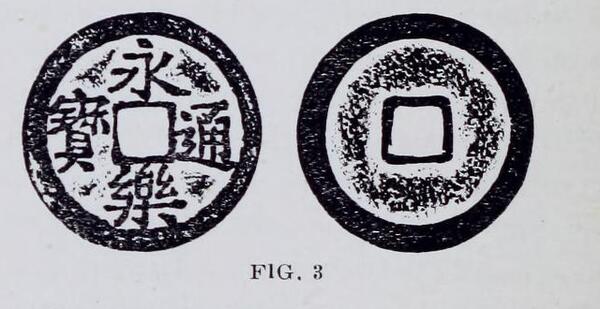
Open on the mapIn 1277 Japanese merchants brought gold to the Yuan to buy copper cash. Three centuries later the Hojo made the imported Ming Eiraku coin the only lawful money of the Kanto and sent bad coin away to the Kyoto region.
Adopted by a state, not issued by it
No one's debt
Claims and evidence
In 1277, between the two Mongol invasions of Japan, Japanese merchants came with gold to exchange for copper cash, and the Yuan court allowed it. Supported Little disputed
“十四年,{{ul|日本}}遣商人持金來易銅錢,許之。”In the fourteenth year [of Zhiyuan, 1277], Japan sent merchants bringing gold to exchange for copper cash; it was permitted.
Song Lian et al., Yuanshi (1370), ch. 208 'Waiyi 1' (Goryeo, Tamna, Japan); Chinese text (Wikisource), Yuanshi 208, Japan
Munro, quoting a Japanese chronicle via Wigmore, reports that the Hojo made the imported Ming Eiraku-sen the only lawful money of the Kanto. Bad coin was gathered and sent to the Kyoto region, where it was nicknamed 'Kyosen', and after 1590 the Kyosen were rated at four to one Eiraku. Supported Little disputed
“called a meeting of some of the chief lords of the region and submitted a proposition prohibiting the use of any money except Eiraku sen.”
Munro, N. G., Coins of Japan (Yokohama, 1904), pp. 93-96, quoting J. H. Wigmore's summary of the Denyen Jikata-Kigen, p. 94“all bad money in every Maclii, Gun, Sho, Go, Mura, and Sato was collected and sent to the Kamigata (or Kyoto region); from this time bad money was called ‘KyotoseiF (or Kyosen).”
Munro, N. G., Coins of Japan (Yokohama, 1904), pp. 93-96, quoting J. H. Wigmore's summary of the Denyen Jikata-Kigen, p. 94“the kyosen came partly into use again and its ratio to the Eiraku sen was fixed at 4 to 1.”
Munro, N. G., Coins of Japan (Yokohama, 1904), pp. 93-96, quoting J. H. Wigmore's summary of the Denyen Jikata-Kigen, pp. 94-95“Hojo Ujiyasu collected it in the Kwanto and excluded the other sen, Shima, Chinese, and Bita sen.”
Munro, N. G., Coins of Japan (Yokohama, 1904), pp. 93-96, quoting J. H. Wigmore's summary of the Denyen Jikata-Kigen, p. 96“the Eiraku sen had begun to displace the ordinary money (akusen, bad money) in the Kwanto.”
Munro, N. G., Coins of Japan (Yokohama, 1904), pp. 93-96, quoting J. H. Wigmore's summary of the Denyen Jikata-Kigen, Munro 1904, p. 94 (later period: Ming coins as Japan's money)