An Atlas of Money · All entries
Switzerland: cantonal coins and foreign silver, replaced by the federal franc (1850)
Attested Little disputed
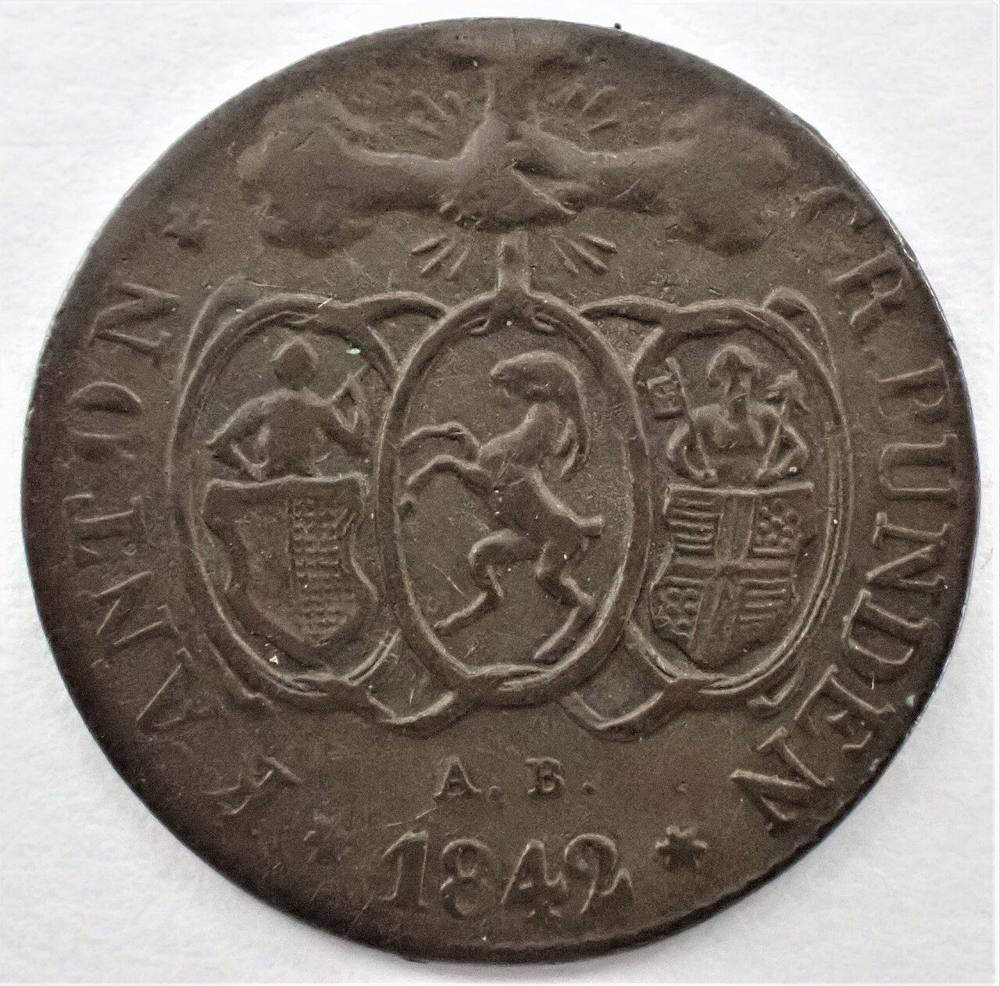
Open on the mapBefore 1848 coinage was a cantonal right. The old Swiss franc varied from canton to canton, and circulation was mostly Austrian, South German and French silver. Murray (1843) found French money current almost everywhere and florin accounts in the east. The law of 7 May 1850 adopted the French franc, withdrew cantonal coins and excluded Austrian and German coin. Gold displaced silver; the 1860 law gave French gold legal tender; Switzerland joined the Latin Union (1865).
Adopted by a state, not issued by it
No one's debt
Claims and evidence
Until 1848 coinage belonged to the cantons; indigenous coin was too scarce, and the circulation was mainly Austrian, South German and French silver. Attested Little disputed
“Until the Constitution of 1848, the prerogative of Coinage appertained to the Can- tons”
'Note on the monetary legislation and on the fabrication of money in the Swiss Confederation since 1850', Exhibit D in International Monetary Conference held in Paris, August 1878 (US Senate Exec. Doc. 58, Washington 1879), p. 199, Exhibit D, I. Legislation, p. 199“apart from a very great variety of indigenous Coin, old and new, quite in- sufficient in point of quantity to keep up the circulation of the country, the latter was chiefly composed of Silver Money of Austria, South Germany, and France”
Same, p. 199, p. 199“almost every canton has a Coinage of its”
[John Murray], A Handbook for Travellers in Switzerland and the Alps of Savoy and Piedmont, new ed. (London 1843), Introduction §2 'Money', pp. xii-xv (approx.), §2 Money, p. xii“since he will find French Napoleons and francs current nearly all”
[John Murray], A Handbook for Travellers in Switzerland and the Alps of Savoy and Piedmont, new ed. (London 1843), Introduction §2 'Money', pp. xii-xv (approx.), §2 Money, p. xii“These cantons combined together in 1825 to adopt an uniform”
Murray (1843), §2, §2 Swiss Money, p. xv (first part: Aarau, Bern, Basle, Freyburg, Soleure, Vaud, Vallais; second: Appenzell, St. Gall, Schaffhausen, Thurgovie)“Accounts are kept in florins (24 gulden foot, as in Frankfurt,”
Murray (1843), §2, §2 Swiss Money, p. xv (first part: Aarau, Bern, Basle, Freyburg, Soleure, Vaud, Vallais; second: Appenzell, St. Gall, Schaffhausen, Thurgovie)
The law of 7 May 1850 made the French silver franc the unit, withdrew all old Swiss coins and excluded Austrian and German coins. Gold then drove out silver despite the law; in 1860 French-standard gold was made legal tender; in 1865 Switzerland signed the Latin Union treaty. Attested Little disputed
“The Swiss law of the 7th of May, 1850, put an end to this state of things, as motley as it was inconvenient. It introduced as unit the French franc in Silver”
Exhibit D, International Monetary Conference 1878, p. 199, p. 199“decreed the withdrawal of all the old Swiss Coins, and excluded Austrian and German Coins.”
Same, p. 199“was dis- turbed by the constantly increasing invasion of Gold, which in a few years, notwith- standing the letter of the law, displaced the metal”
Same, p. 199“In 1865, Switzerland, with Belgium, France, and Italy, signed the Treaty of 23d December, which gave birth to the monetary union called Latin”
Same, p. 199