An Atlas of Money · All entries
Switzerland: many banks of issue and a note concordat (1834-1907)
Supported Disputed
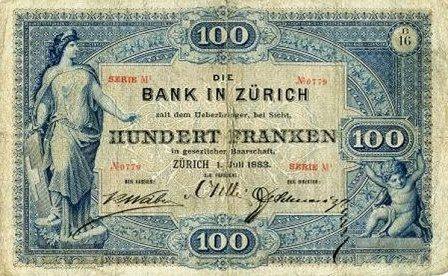
Open on the mapDes Essars (1896): Switzerland had no bank of issue before 1834. Cantonal and private banks then issued their own notes, and from 1864 a French-backed bank arranged that the main banks accept each other's notes. In 1870 holders ran for coin when bills on France froze. Under the federal law of 1875 and the 1876 Concordat, banks redeemed each other's small notes in coin at no charge and cleared through a bureau at the Bank of Zurich. The constitution forbade a federal note monopoly and legal-tender notes.
Private, under state licence or control
A claim on an issuer
Claims and evidence
No Swiss bank of issue existed before 1834; then cantonal and private banks issued notes, and from 1864 the major banks agreed to accept one another's notes. Supported Little disputed
“Before 1834 none were in existence.”
Pierre des Essars, 'Banking in Switzerland', in A History of Banking in All the Leading Nations, vol. 3 (New York: Journal of Commerce, 1896), pp. 287-288, p. 287“the Eidgenossische Bank made an arrangement with the Banks of Basle, Zurich, and St. Gall by which they would mutually accept each other's paper money.”
Des Essars (1896), p. 288, p. 288
In 1870 Swiss note holders, fearing forced circulation, ran on the banks for coin because Switzerland depended on bills on France for its specie. Supported Little disputed
“Everybody knew that Switzerland depended absolutely upon France for its supply of coin, and the banks' clients, who feared a forced circulation of the paper issue, rushed upon the banks for redemption of their notes in coin.”
Des Essars (1896), p. 288, p. 288
The constitution barred a federal note monopoly and legal-tender notes. Under the 1876 Concordat each bank redeemed the others' notes of 50 francs and under in coin without charge, clearing through a central bureau at the Bank of Zurich. Supported Disputed
Contested by Whether this was free banking is disputed: entry and note limits were set by cantonal and, from 1875 and 1881, federal law, and many issuers were cantonal (state) banks.
“the constitution prohibits a monopoly of the right to issue and of making bank notes legal tender”
Des Essars (1896), p. 289, p. 289 (summarising the Federal Council message of 16 June 1874)“each bank engaged itself to accept notes of fifty francs and under, issued by”
Des Essars (1896), pp. 289-290, pp. 289-290“banks in the agreement, from all who presented such at their main offices, and to redeem them in coin without cost.”
Des Essars (1896), pp. 289-290, pp. 289-290“The Bank of Zurich took upon itself to direct and supervise a Central Bureau at which each bank should have an account, and where the clearing of reciprocal credits should be effected.”
Des Essars (1896), p. 290, p. 290