An Atlas of Money · All entries
Dentalium shell money
Attested Little disputed
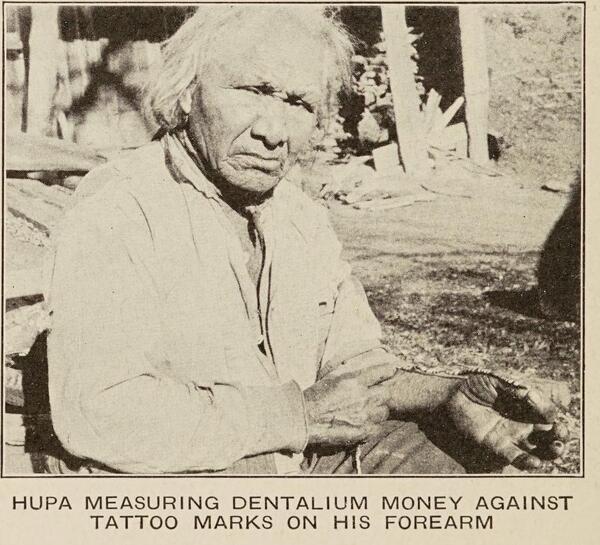
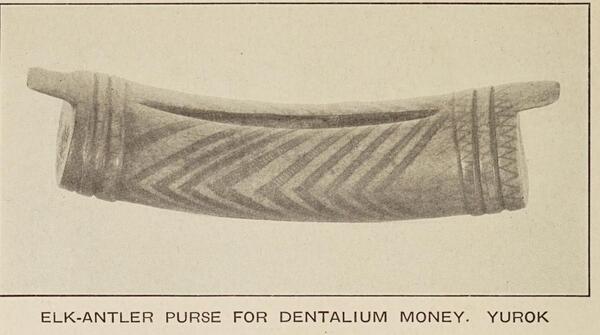
Open on the mapKroeber records dentalium as the money of the Yurok: graded by length, strung and measured against tattooed arm-marks, with fixed tariffs for brides, wergild and goods (e.g. a 12-shell string worth US$10 in his time). The shells came from Vancouver Island waters.
No state involved
No one's debt
Claims and evidence
Kroeber records dentalium as the money of the Yurok: graded by length, strung and measured against tattooed arm-marks, with fixed tariffs for brides, wergild and goods (e.g. a 12-shell string worth US$10 in his time). The shells came from Vancouver Island waters. Attested Little disputed
“The money of the Yurok was dentalium shells.”
Kroeber, A. L., Handbook of the Indians of California, BAE Bulletin 78 (1925), pp. 22-27
On the Washington coast in 1852–55 Swan found dentalium passing as money, called 'Siwash dollars', and displayed by women as wealth. Attested Little disputed
“It passes as money among them, and is called Siwash dol- lars.”
J. G. Swan, The Northwest Coast; or, Three Years' Residence in Washington Territory (1857), pp. 158-159“As these shells are evidences of wealth, the women are anxious to display as many as they can on great occa- sions.”
Swan (1857), p. 159
Among the Karuk of the Klamath in the 1870s Powers found red woodpecker scalps ($2.50 to $5 apiece) and strung dentalium used as money; a murder could be compounded for a string, the price of an average life. Dentalium lost value as supply grew after the Americans came. Attested Little disputed
“For money they make use of the red scalps of woodpeckers, which rate at $2.50 to $5 apiece; and of the dentalium shell,”
Stephen Powers, Tribes of California, Contributions to North American Ethnology vol. III (1877), ch. I, The Karok“The murder of a man's dearest relative may be com- pounded for by the payment of money, the price of the average Indian's life being i'-sa pchso-ra (one string).”
Powers (1877), ch. I, The Karok“When the Americans firet arrived in the country, an Indian would give $40 or $50 gold for a string,”
Powers (1877), ch. I, The Karok