An Atlas of Money · All entries
Josiah Warren's labor notes (Cincinnati and Utopia)
Supported Little disputed
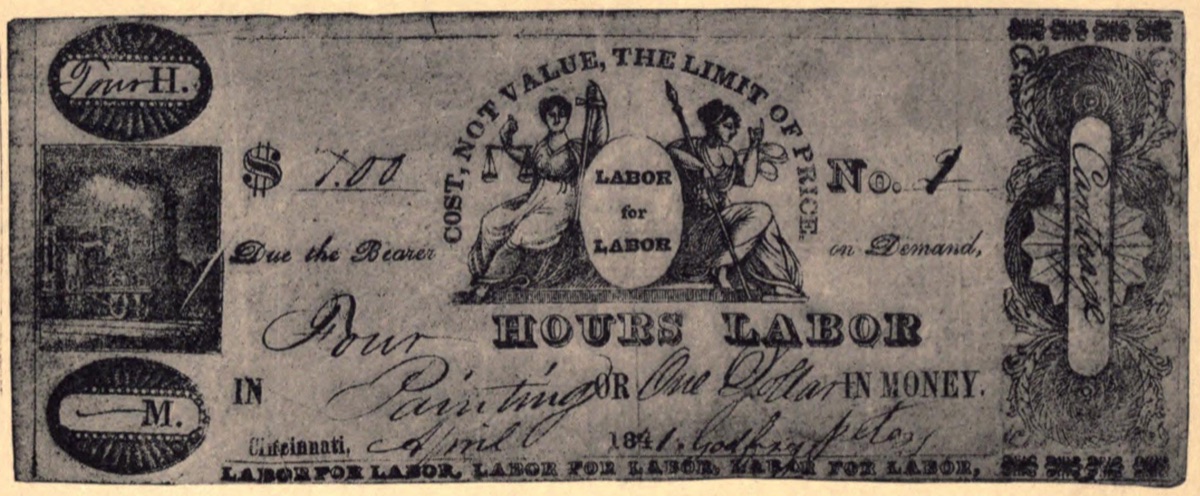
Open on the mapJosiah Warren opened a 'Time Store' in Cincinnati on 18 May 1827. Goods were sold at cost in lawful money; the storekeeper's time was paid in the customer's labor note, a promise of so many minutes of the customer's own work. The store also took goods on deposit against Warren's notes, which were reckoned in hours, not dollars; in 1828 he held the notes of three physicians. At the Utopia settlement in Ohio the mill owner issued notes payable in lumber, and a settler paid for his lot in his own labor notes. No state issued or enforced these notes; people took them by choice.
No state role recorded
A claim on an issuer
Claims and evidence
Warren's Time Store opened in Cincinnati on 18 May 1827. Customers paid for goods in money at cost and for the storekeeper's time in their own labor notes. Supported Little disputed
“On the 18th of May, 1827, there was opened unpretentiously at the corner of Fifth and Elm Streets in Cincinnati a little country store,”
William Bailie, Josiah Warren, the First American Anarchist (Boston, 1906), ch. II, p. 9“the customer gives his labor note, something after this form: "Due to Josiah Warren, on demand, thirty minutes in carpenter work — John Smith."”
William Bailie, Josiah Warren, the First American Anarchist (Boston, 1906), ch. II, p. 10
Depositors of goods could take Warren's labor notes, reckoned in hours, not dollars; in November 1828 he held the labor notes of three physicians. Supported Little disputed
“as these labor notes were expressed in hours and not in dollars,”
William Bailie, Josiah Warren, the First American Anarchist (Boston, 1906), ch. II, p. 11“I have on hand at this moment (Nov. 28, 1828), the labor notes of three physicians”
William Bailie, Josiah Warren, the First American Anarchist (Boston, 1906), ch. II, p. 15, quoting Warren's diary
At Utopia the mill owner issued labor notes payable in lumber; H. B. Lyon paid for his lot with his own notes, which the mill took for lumber and he redeemed by tending the mill. Supported Little disputed
“The owner of the mill issued his labor notes payable in lumber. H. B. Lyon paid for his lot with his labor notes.”
William Bailie, Josiah Warren, the First American Anarchist (Boston, 1906), ch. on Utopia, p. 53, quoting Warren's notes“the owner of the mill took them of the landowner for lumber, and Mr. Lyon redeemed them in tending the mill.”
William Bailie, Josiah Warren, the First American Anarchist (Boston, 1906), ch. on Utopia, pp. 53-54, quoting Warren's notes