An Atlas of Money · All entries
Pennsylvania, 1723: the General Loan Office and its bills of credit
Attested Little disputed
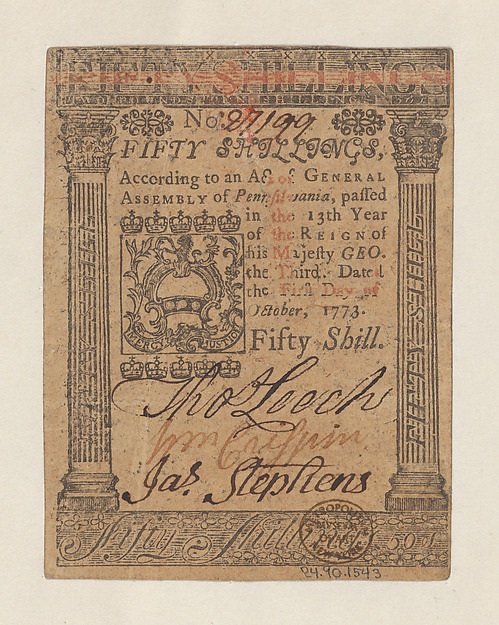
Open on the mapPennsylvania's act of 1722-23 emitted £15,000 in bills of credit and set up a General Loan Office in Philadelphia to lend £11,000 of them at 5% for eight years, on mortgages of land worth at least double, or houses worth three times, the loan. A tender of the bills discharged any debt or contract, past or future. Franklin, who wrote for a further issue in 1729 and printed the money, says the dollar stayed at 7s 6d in Pennsylvania paper for near forty years while the paper grew from £15,000 to as much as £600,000.
State-issued
A claim on an issuer
State notes · Land-backed notes
Claims and evidence
The act empowered trustees to lend £11,000 of the £15,000 in bills at 5% a year for eight years, in sums of £12 10s to £100, taking mortgages on land worth at least double, or houses worth three times, the sum lent, through a General Loan Office in Philadelphia. Attested Little disputed
“let out the value of eleven thousand pounds of the said bills upon loan, at the interest of five per cent per annum for the term of eight years”
The Statutes at Large of Pennsylvania from 1682 to 1801, vol. 3 (Harrisburg, 1896), 'An act for the emitting and making current fifteen thousand pounds in bills of credit' (1722-23), sec. III“the said trustees taking a security by way of mortgage in at least double the value of lands and ground rents, lying in this province, and in (at least) three times the value of houses”
The Statutes at Large of Pennsylvania from 1682 to 1801, vol. 3 (Harrisburg, 1896), 'An act for the emitting and making current fifteen thousand pounds in bills of credit' (1722-23), sec. III“there shall be one public office kept in the city of Philadelphia, which shall be called The General Loan Office of Pennsylvania”
The Statutes at Large of Pennsylvania from 1682 to 1801, vol. 3 (Harrisburg, 1896), 'An act for the emitting and making current fifteen thousand pounds in bills of credit' (1722-23), sec. IV
A tender of the bills was made a discharge of any debt, bargain, sale of land, bond, mortgage or contract, already made or to be made. Attested Little disputed
“the tender of the said bills for payment or discharging of any debt or debts, bargain, sale of lands, or other things, bonds, mortgages, specialties and contracts whatsoever, already made, or hereafter to be made”
The Statutes at Large of Pennsylvania from 1682 to 1801, vol. 3 (Harrisburg, 1896), 'An act for the emitting and making current fifteen thousand pounds in bills of credit' (1722-23), sec. VI
Counterfeiters were to lose both ears and be whipped with thirty-one lashes. Attested Little disputed
“have both his or her ears cut off, and be publicly whipped on his or her bare back with thirtyone lashes, well laid on”
The Statutes at Large of Pennsylvania from 1682 to 1801, vol. 3 (Harrisburg, 1896), 'An act for the emitting and making current fifteen thousand pounds in bills of credit' (1722-23), sec. X
An Assembly committee reported in 1739 that £45,000 had been emitted in 1723, £6,110 5s burnt in 1726 and £30,000 emitted in 1729, with £68,889 15s in circulation; the total was raised to £80,000. Supported Little disputed
“there were emitted <£45,000 of which in 1726 there were burnt 6,110 5s. In 1729 there were emitted 30,000 and that the amount now in circulation was 68,889 15s.”
Henry Phillips Jr., Historical Sketches of the Paper Currency of the American Colonies, first series (Roxbury, 1865), pp. 18-19
Franklin wrote a pamphlet for more paper in 1729, arguing that bills issued on land are 'in effect Coined Land', and was then employed to print the money; he says the paper grew to £55,000, £80,000 in 1739 and over £350,000 in the war. Attested Little disputed
“For, as Bills issued upon Money Security are Money, so Bills issued upon Land, are in effect Coined, Land,.”
Benjamin Franklin, A Modest Enquiry into the Nature and Necessity of a Paper-Currency (Philadelphia, 1729), in A. H. Smyth (ed.), The Writings of Benjamin Franklin, vol. 2 (New York, 1905), p. 147“My friends there, who conceiv'd I had been of some service, thought fit to reward me by employing me in print-”
Benjamin Franklin, Autobiography, in A. H. Smyth (ed.), The Writings of Benjamin Franklin, vol. 1 (New York, 1905), p. 306“so that it grew soon to fifty-five thousand pounds, and in 1739 to eighty thousand pounds, since which it arose during war to upwards of three hundred and fifty thousand pounds”
Benjamin Franklin, Autobiography, in A. H. Smyth (ed.), The Writings of Benjamin Franklin, vol. 1 (New York, 1905), p. 307
In 1767 Franklin wrote that the dollar had stood at 7s 6d in Pennsylvania paper for near forty years without change on new emissions, though the paper had at times grown from £15,000 to £600,000. Attested Little disputed
“it has continued uniformly at those Rates in both Provinces now near forty Years, without any Variation upon new Emissions”
Benjamin Franklin, 'Remarks and Facts concerning American Paper Money' (1767), in A. H. Smyth (ed.), The Writings of Benjamin Franklin, vol. 5 (New York, 1906), pp. 10-11“tho' in Pennsylvania the Paper Currency has at times increased from £15,000 the first Sum, to £600,000”
Benjamin Franklin, 'Remarks and Facts concerning American Paper Money' (1767), in A. H. Smyth (ed.), The Writings of Benjamin Franklin, vol. 5 (New York, 1906), p. 11
Connections
- Britain's Currency Act of 1764
- Pennsylvania, 1780–1786: tender laws, the Assembly's paper money and the Bank of North America's notes
- Rhode Island, 1710-1764: bills of credit, the land 'banks' and silver at 8s to 27s an ounce
- Massachusetts Land Bank
- Maryland, 1733-1765: bills of credit paid off from Bank of England stock
Keep exploring
Same money
- The Cantillon effect: who gains from new money
- Louisiana: treasury notes, royal cards and their 5:2 retirement, 1727-1745
- Japan, c. 1600–1867: Yamada hagaki and domain notes — paper money the shogunate could not stop
- Louisiana: war bons, the 1759 stop of payment and D'Abbadie's 75% cut, 1756-1768
- New Orleans, 1768: the Superior Council expels Ulloa, naming the unpaid royal paper
Same region, same era
- Albany against Montreal: the price of beaver
- Virginia, 1730-1776: tobacco transfer notes on the public warehouses
- Massachusetts, 1690: bills of credit paid to the soldiers of the failed Quebec expedition
- Upper Ohio frontier: 'fur and peltry were the people's money'
- Augusta, 1773: trade debts paid in land