Money in United States
Entries placed by today's borders.
Entries 184, in 4 eras
Span AD 0–2026
Kinds of money Gold coin 27, Silver coin 23, US dollar 22, State notes 19, Ledger credit 14, and 53 others
W ithin the present-day United States, the atlas places 184 entries, by their main place or a dated one, from AD 0 to 2026. The oldest is Chumash shell beads: money, and how old? (AD 0–1792); the most recent, Florida: gold and silver coin as legal tender for debts (2026). The money named most often is Gold coin, in 27 entries.
The word for money
- English money: Latin moneta 'mint', a surname of Juno in whose temple at Rome coin was struck dictionaries disagree. Skeat, W. W., An Etymological Dictionary of the English Language, new ed. (Oxford, 1898), s.v. MONEY More on the word for money →
Antiquity 3000 BC – AD 499
1 entry, AD 0–1792
each one giving to the chief celebrant a string of beads, something over a span in length.Pedro Fages, An Historical, Political, and Natural Description of California (1775), transl. H. I. Priestley, Catholic Historical Review 4 (1919), part 1, section La Carpintería to Punta de los Pedernales
Listed below, not drawn (too far away for this map): entries elsewhere that share this era's money (Shell beads).
List of entries (1, and 3 elsewhere)
- 1 Chumash shell beads: money, and how old? AD 0–1792
Elsewhere
- Maya stone and shell beads as money Yucatán peninsula, 1500
- Hochelaga, 1535: shell beads used as gold and silver Hochelaga, 1535
- Quiripa shell-bead currency Middle Orinoco, 1550
Middle period 500–1499
1 entry, 1000–1250
the presence of all shell elements reveals that whole lightning whelk shells (Busycon sinistrum) were transported to Cahokia for artifact manufacture, probably after being de-fleshed.Kozuch 2003, abstract and p. 83
List of entries (1)
Early modern 1500–1899
134 entries, 1524–2026

they took from us only knives, fish hooks and sharpened steel.Giovanni da Verrazzano, letter to Francis I (1524), in Winship (1905), northern coast section
Listed below, not drawn (too far away for this map): entries elsewhere that share this era's money (Blankets, Glass beads, Iron implements, Land-backed notes) or that its sources name.
List of entries (134, and 8 elsewhere)
- 1 New England coast, 1524: copper over gold, trade by cord 1524
- 2 Cíbola, 1539: turquoise and hides for labour (reported) 1539
- 3 Cofitachequi, 1540: pearls with the dead 1540
- 4 Cayas, 1541: salt carried off to trade 1541
- 5 Plains hides for Pueblo corn and cloth 1541–1583
- 6 Calusa, c. 1549–66: tribute to the chief, and silver from wrecks 1549–1566
- 7 Wampum 1600–1700
- 8 Tobacco as currency in colonial Virginia 1616–1699
- 9 New Mexico, 1630s: no coin; pay and tribute in hides and blankets 1630–1639
- 10 Connecticut, 1704: pay, pay as money, money and trust 1633–1704
- 11 Massachusetts mint, 1652-1682: NE, willow, oak and pine tree shillings 1652–1682
- 12 Maryland, 1659-1662: Lord Baltimore's shillings 1659–1662
- 13 Made Beaver: Hudson's Bay unit of account (today in the United States) 1678–1908
- 14 Albany, 1684: beaver skins as tokens and satisfaction 1684–1712
- 15 Massachusetts, 1690: bills of credit paid to the soldiers of the failed Quebec expedition 1690–1751
- 16 Red River to San Antonio, 1690–1778: horses, mules and captives as payment 1690–1778
- 17 Hasinai (Caddo), 1691: barter only, no gold or silver 1691
- 18 Shell and glass beads in the Southeast 1700–1775
- 19 Rhode Island, 1710-1764: bills of credit, the land 'banks' and silver at 8s to 27s an ounce 1710–1764
- 20 Louisiana: Company of the Indies storehouse orders and card money, 1717-1733 1717–1733
- 21 Louisiana: 'Colonie Françoise' copper made legal tender, 1721-1727 1721–1727
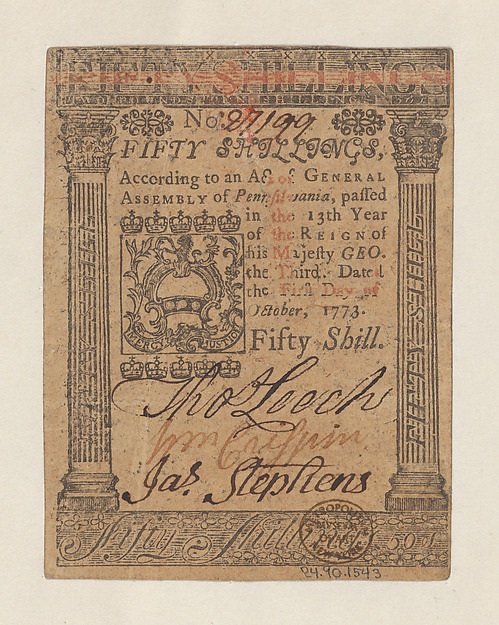
- 22 Pennsylvania, 1723: the General Loan Office and its bills of credit 1723–1767
- 23 Albany against Montreal: the price of beaver 1724–1737
- 24 Louisiana: treasury notes, royal cards and their 5:2 retirement, 1727-1745 1727–1745
- 25 Virginia, 1730-1776: tobacco transfer notes on the public warehouses 1730–1776
- 26 Taos fair, 1731–1761: hides and captives for horses and iron 1731–1761
- 27 Mobile and the Alibamon, 1732-1735: deerskins graded by weight and priced in cloth 1732–1735
- 28 Maryland, 1733-1765: bills of credit paid off from Bank of England stock 1733–1765
- 29 Deerskins as unit of value 1733–1775
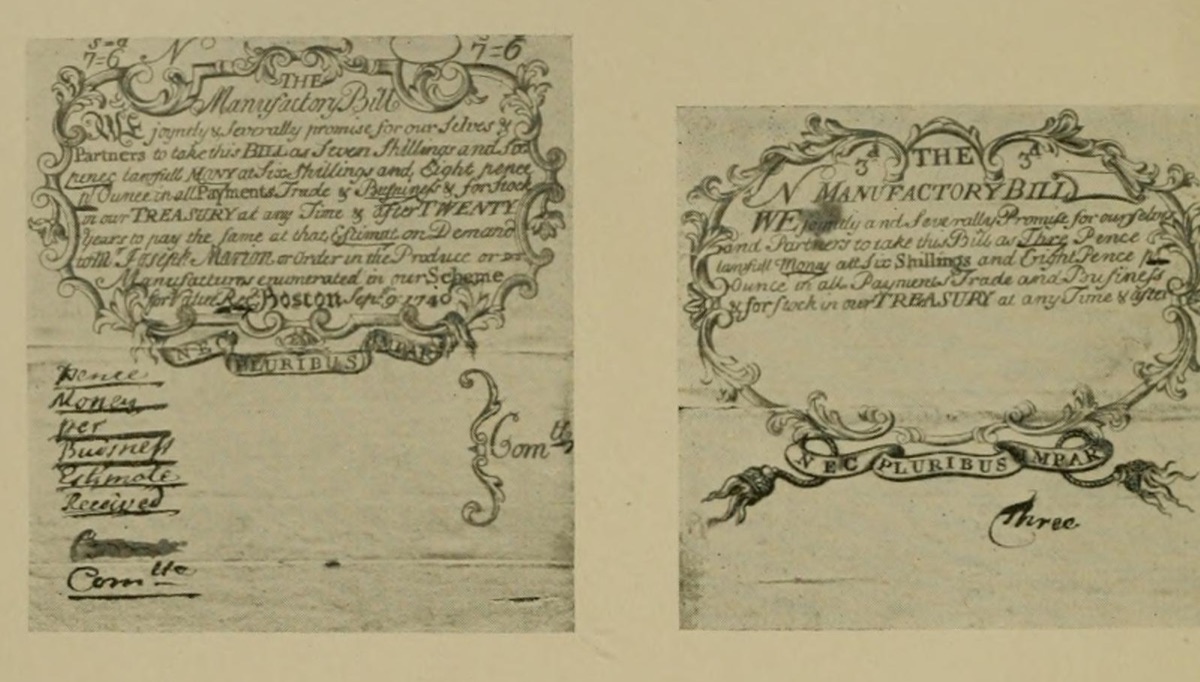
- 30 Massachusetts Land Bank 1740–1741
- 31 Aleuts: values once reckoned in slaves (kalgi), later in roubles 1740–1834
- 32 Aleutian Islands, 1749-1764: tribute in sea-otter skins, child hostages, beads for skins 1749–1764
- 33 Texas presidios, to 1772: soldiers paid in goods at the captain's prices (today in the United States) 1751–1772
- 34 East Texas, 1751–1775: governors trading French goods against the law 1751–1775
- 35 Louisiana: war bons, the 1759 stop of payment and D'Abbadie's 75% cut, 1756-1768 1756–1768
- 36 British West Florida, 1763-66: Spanish dollars, Treasury bills and no cash 1763–1766
- 37 West Florida, 1763-66: treaty tariffs in pounds of leather, and presents to the chiefs 1763–1766
- 38 Upper Ohio frontier: 'fur and peltry were the people's money' 1763–1783
- 39 Britain's Currency Act of 1764 1764
- 40 Augusta, 1773: trade debts paid in land 1765–1773
- 41 New Orleans, 1768: the Superior Council expels Ulloa, naming the unpaid royal paper 1766–1768
- 42 New Mexico: pesos de la tierra 1767–1788
- 43 Natchitoches: trade goods on credit, repaid in skins at fixed rates 1770
- 44 Seminole canoe trade with Cuba 1774
- 45 Seminole credit at Spalding's store 1774
- 46 Continental currency 1775–1790
- 47 The Mojave, 1776: white sea-shells, the good taken in exchange 1776
- 48 Kauaʻi, 1778: small pigs for a sixpenny nail 1778
- 49 San Antonio de Béxar, 1779: stock priced in pesos, paid in coin or drafts 1779
- 50 Hawaiʻi, 1779-1839: tribute to the chiefs in feathers, cloth, hogs and traded iron 1779–1839
- 51 Continental Congress, 1780: supplies requisitioned from the states in kind, credited in Spanish dollars 1780–1781
- 52 Pennsylvania, 1780–1786: tender laws, the Assembly's paper money and the Bank of North America's notes 1780–1786
- 53 North Carolina, 1781–82: bounty and pay certificates paid "as soon as the situation of the finances will permit" 1781–1782
- 54 New York and Pennsylvania, 1781–1790: light 'Birmingham coppers' and the Machin's Mills mint 1781–1790
- 55 Northern Northwest Coast: sea-otter skin, then the blanket 1785–1887
- 56 US federal law on gold, silver and bitcoin as money 1789–2026
- 57 Kodiak, 1790: a four-foot string of beads for each sea-otter, under hostages 1790
- 58 First Bank of the United States (1791-1811) 1791–1811
- 59 US bimetallism: gold leaves circulation, 1792-1834 1792–1834
- 60 US dollar 1792–2026
- 61 Jefferson's letter of general credit for Lewis, 1803: the faith of the United States in place of money 1803–1806
- 62 Knife River villages: horses priced in guns and beaver skins 1804–1806
- 63 Shoshone: horses for a coat and knives 1805
- 64 Glass beads on the Lower Columbia 1805–1806
- 65 Fort Clatsop to the Nez Perce, 1806: when the trade goods ran out, buttons, a laced coat and eyewater 1806
- 66 United States, 1812–1850: Treasury notes of the War of 1812 and the Mexican War 1812–1850
- 67 Fort Okanagan: skins sorted into lots 1813–1817
- 68 Bank suspensions of specie payment (1814; 1837; 1857) 1814–1857
- 69 Dentalium shell money 1814–1925
- 70 US trading factories that would not give credit 1815–1816
- 71 Panic of 1819 1815–1822
- 72 Russian-American Company skin and parchment scrip ('leather money') (today in the United States) 1815–1867
- 73 Second Bank of the United States (1816-36) and Jackson's Bank War 1816–1836
- 74 Hawaiian chiefs' sandalwood: ships, fines and a national debt paid in piculs, 1810s-1830 1819–1830
- 75 Unalaska, 1820s-1830s: the Company as sole buyer of furs, at a government tariff 1821–1834
- 76 Mexican Texas: 'hammered dollars' at 90 cents beside 'eagle money' at 100 1821–1850
- 77 Austin's colony, 1823–24: land fees in cattle, horses, cotton and 'Land office money' 1823–1834
- 78 Unalaska: Aleut barter through a go-between; owner and buyer never meet 1824–1834
- 79 Suffolk system, 1825–1858: a private Boston bank clears New England's bank notes at par 1825–1858
- 80 Josiah Warren's labor notes (Cincinnati and Utopia) 1827–1848
- 81 Templeton Reid's mint, Gainesville, Georgia, 1830: underweight and gone in three months 1830
- 82 Buffalo robes as money (today in the United States) 1830–1880
- 83 The Bechtler mint, Rutherfordton, North Carolina, 1831–c. 1852 1831–1852
- 84 Green River rendezvous: trappers on credit 1833
- 85 Alta California: hides as 'California bank notes' 1835
- 86 Specie Circular (1836): gold, silver or Virginia land scrip 1836
- 87 Green River rendezvous: beaver against dollar prices 1836–1837
- 88 Republic of Texas, 1836–42: audited drafts, star notes and 'red backs' (from par to about 15 cents) 1836–1850
- 89 1837 'shinplasters' (private small notes) 1837–1839
- 90 Michigan, 1837–1844: the general banking law, borrowed specie and boxes of nails and glass 1837–1844
- 91 US free-bank and 'wildcat' notes 1837–1863
- 92 Comanche mule trade on the Canadian River 1839
- 93 Hawaiian Kingdom, 1839-1841: poll tax in dollars, land tax in pigs weighed by the pound, arrowroot where no dollar was had 1839–1846
- 94 Republic of Texas, 1842–45: red backs refused for taxes; exchequer bills taken only at market rate 1842–1845
- 95 New Braunfels, 1846: no cash, so trade by entries in the Adelsverein's ledgers 1846
- 96 San Antonio, 1846: Mexican caravans pay in silver dollars and smuggle the goods home 1846
- 97 Texas frontier, 1846–47: Comanche mules taken in Mexico, sold at Torrey's post; a captive offered for 40 dollars 1846–1847
- 98 Honolulu, 1846-1884: any state's gold and silver at its market value, and the copper 'hapa haneri' 1846–1884
- 99 San Saba, 1847: the Meusebach–Comanche treaty, land opened for gifts worth 1,000 dollars 1847
- 100 California gold dust and private mints 1848–1855
- 101 Mormon gold, Salt Lake City, 1849: far underweight and refused 1849
- 102 Oregon Exchange Co., Oregon City, 1849: gold coin above standard 1849
- 103 Country newspapers paid in wood and produce 1850–1877
- 104 Gold clauses, 1851–1896: contracts payable in coin, upheld against the greenback 1851–1896
- 105 Ohio and Indiana, 1854: Ohio outlaws small out-of-state notes and Indiana's free-bank notes fall to 25% discount 1854–1856
- 106 Clearinghouse loan certificates (1857-1914) 1857–1914
- 107 Denver: gold dust and Clark, Gruber coin 1859–1860
- 108 Wisconsin, 1861: Southern bonds collapse and the state stays redemption of bank notes 1860–1861
- 109 US Civil War tokens 1861–1864
- 110 Comstock: gold and silver coin, greenbacks at a discount 1862–1876
- 111 Greenbacks 1862–1879
- 112 California, 1862–1880: gold coin kept, greenbacks taken only at market value 1862–1880
- 113 Montana: gold dust as the only money 1863–1865
- 114 National Banking Acts (1863-64) and 10% tax on state bank notes (1865) 1863–1913
- 115 Andersonville: uniform buttons as prices 1864
- 116 Norton Sound and the Yukon: prices in musket-balls and tobacco 1866–1868
- 117 Bering Strait skin unit of value 1867–1881
- 118 Aleutians and western Alaska, 1870s-1880s: furs against goods and debt at Alaska Commercial Company stations 1870–1888
- 119 Pribilof seal islands, 1870-1890: 40 cents a skin in coin, credited on the company's books 1870–1890
- 120 Clamshell disc-bead money (Pomo and southern California) 1871–1925
- 121 Obsidian blades of northwestern California: wealth, and money? 1872–1925
- 122 Coinage Act of 1873 ('Crime of '73') 1873
- 123 Panic of 1873 1873–1879
- 124 Norton Sound: the Asking festival 1877–1881
- 125 US silver certificates, 1878–1968: receipts for silver dollars, redeemable in silver until 24 June 1968 1878–1968
- 126 The Pueblos, 1880–85: shell beads and turquoise beside coin 1880–1885
- 127 Point Barrow: bear meat divided, whalebone bought up 1881–1883
- 128 US scrip acts: wages in money, not store orders 1881–1967
- 129 Kalākaua's silver, 1883-1884: a million dollars struck at San Francisco, and the merchants' push for gold 1883–1884
- 130 Southern West Virginia coalfields, from 1883: peddlers paid in eggs and produce 1883–1929
- 131 West Virginia coal towns: company scrip, discounted outside the store 1887–1955
- 132 Pribilof seal islands, 1890-1910: 50, then 75 cents a skin, credited on the company's books and drawn on the agent's orders 1890–1910
- 133 Panic of 1893 1893–1897
- 134 Bryan's 'Cross of Gold' (1896) and the Gold Standard Act (1900) 1896–1900
Elsewhere
- East Texas, 1751–1775: governors trading French goods against the law Saltillo 1751
- Assignats Paris, 1790
- Made Beaver: Hudson's Bay unit of account Chipewyan 1830
- Kwakwaka'wakw blankets and coppers Fort Rupert, 1849
- Herero (Damara) cattle priced in iron: an assegai for an ox Central Namibia, 1850
- Wadai: cloth for money, beads for small change Abeshe, 1851
- Unyamwezi: beads, cloth and wire as currency Msene, 1857
- Kei Islands: knives, cloth and arrack for money Moluccas, 1857
Modern 1900 to today
48 entries, 1900–2026


In 1900 annexation to the United States abolished the coolie system.Labor Conditions in Hawaii: Fifth Annual Report of the Commissioner of Labor Statistics on Hawaii, 1915 (Washington: GPO, 1916), p. 9
List of entries (48)
- 1 Nome and Council City: gold dust at $16 an ounce 1900–1901
- 2 Hawaiian sugar plantations, 1900-1915: indentures voided, then store credit and advances on the cane contract 1900–1915
- 3 US gold certificates, 1900–1934: receipts for gold held to pay them 1900–1934
- 4 Coal-company scrip (Stearns Coal and Lumber, Big South Fork) 1902–1947
- 5 Colville and Point Barrow Inuit: fish piles shared, dance gifts repaid 1906–1912
- 6 Panic of 1907: Knickerbocker Trust and J.P. Morgan's rescue 1907–1908
- 7 Jekyll Island meeting 1910
- 8 Pribilof Islands under the Bureau of Fisheries, 1910-1912: $1 a skin credited at the government store, drawn weekly in supplies 1910–1912
- 9 Federal Reserve Act 1913–2026
- 10 Bank runs of 1930-33 and the 1933 bank holiday 1930–1933
- 11 Tenino wooden money 1931–1933
- 12 US stamp scrip, 1932-34 1932–1934
- 13 Bankhead-Pettengill stamp scrip bill (1933) 1933
- 14 Chicago Plan for 100% reserve money 1933–1935
- 15 Executive Order 6102 (1933): gold surrender 1933–1974
- 16 FDIC and the Banking Act of 1933 1933–2026
- 17 United States, 1935: states consider coining mills for the sales tax 1935
- 18 Hawaii, 1942: all dollars swapped for notes overprinted HAWAII 1942
- 19 Federal Reserve yield peg and the Treasury–Fed Accord, 1942–1951 1942–1951
- 20 Bretton Woods 1944–1971
- 21 Rothbard, The Case for a 100 Percent Gold Dollar (1962) 1962–1996
- 22 United States, 1965–1971: silver taken out of the coins 1965–1971
- 23 Amish mutual aid in place of Social Security: the 1965 exemption 1965–2026
- 24 Gold window closed 1971
- 25 The Hunt silver episode, 1979–80: silver to $48 and back, and silver out of households 1979–1980
- 26 United States, 1979–2011: dollar coins the public would not use 1979–2011
- 27 Idaho: gold and silver, untaxed and then legal tender 1984–2026
- 28 Ithaca HOURS 1991–1998
- 29 e-gold 1996–2008
- 30 Liberty Dollar (NORFED) 1998–2011
- 31 Linden dollars (Second Life) 2006–2011
- 32 BerkShares 2006–2015
- 33 California, 2009: registered warrants (IOUs) instead of cash 2009
- 34 Bitcoin's first exchange rate (New Liberty Standard) 2009–2010
- 35 Bitcoin's first priced purchase 2010
- 36 Utah: gold and silver coin as legal tender (2011) 2011–2026
- 37 Oklahoma: gold and silver coin as legal tender 2014–2026
- 38 The Narrow Bank (TNB USA Inc.) 2017–2020
- 39 Arizona: no state tax on gains from gold and silver coin 2018–2026
- 40 Wyoming: gold and silver specie as legal tender 2018–2026
- 41 Custodia Bank (Wyoming SPDI) 2020–2026
- 42 Arkansas: gold and silver coin as legal tender 2023–2026
- 43 Louisiana: gold and silver as legal tender 2024–2026
- 44 Missouri: the Constitutional Money Act 2025–2026
- 45 The GENIUS Act: rules for dollar payment stablecoins 2025–2026
- 46 United States: ban on a retail central bank digital currency 2025–2026
- 47 Florida: gold and silver coin as legal tender for debts 2026
- 48 Texas: privately minted gold and silver as legal tender 2026
What this cannot show
- How much money of each kind was in use: the marks count entries, not coins, notes or goods.
- A census: the atlas seeks out money made without a state, so an era with few entries is not an era with little money.
- The past's borders: entries are placed by today's, and the same money often ran beyond them; see the map.
Sources quoted on this page
- Pedro Fages, An Historical, Political, and Natural Description of California (1775), transl. H. I. Priestley, Catholic Historical Review 4 (1919), part 1
- Kozuch 2003, abstract and p. 83
- Giovanni da Verrazzano, letter to Francis I (1524), in Winship (1905)
- Labor Conditions in Hawaii: Fifth Annual Report of the Commissioner of Labor Statistics on Hawaii, 1915 (Washington: GPO, 1916)