Money in Romania
Entries placed by today's borders.
Entries 7, in 3 eras
Span 600 BC – 1985
Kinds of money Greek coin 3, Arrowhead money 2, Roman denarius 1, Gold coin 1, Grosso 1, and 4 others
W ithin present-day Romania, the atlas places 7 entries, by their main place or a dated one, from 600 BC to 1985. The oldest is Tomis: cast monetary signs and gold staters (600 BC–72 BC); the most recent, Kent cigarettes as money in Ceausescu's Romania (1975–1985). The money named most often is Greek coin, in 3 entries.
Antiquity 3000 BC – AD 499
5 entries, 600 BC – 616

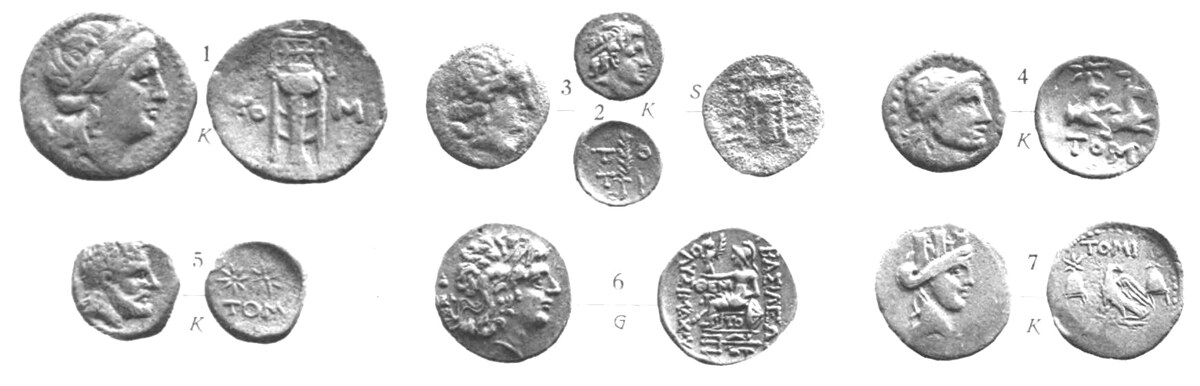


Since the monetary instruments were included in the funerary deposit to pay the fee to Charon, the transporter of the soul to the afterlife, they must have been intended to be used as a medium of exchange.Gabriel Mircea Talmațchi, 'Arrowheads and Dolphins: Pre-coinage Monetary Instruments from the Western Black Sea (5th c. BC)', Journal of Ancient History and Archaeology 11.4 (2024), pp. 342-344, DOI 10.14795/j.v11i4.1154
Hollow marks: entries elsewhere that share this era's money (Arrowhead money, Greek coin, Roman denarius) or that its sources name.
List of entries (5, and 8 elsewhere)
- 1 Tomis: cast monetary signs and gold staters 600 BC–72 BC
- 2 Istros: arrowhead money, gold staters and late coin finds 600 BC – 616
- 3 Lysimachos and the posthumous west-Pontic staters (today in Romania) 306 BC–72 BC
- 4 Dacia, c. 75 BC–AD 106: Roman denarii and their Dacian copies 75 BC – AD 106
- 5 Koson gold staters, mid-1st century BC 50 BC–25 BC
Elsewhere
- a Arrowhead and dolphin money at Olbia Olbia, 600 BC
- b Lysimachos and the posthumous west-Pontic staters Mesambria 250 BC
- c Ptolemaic grain banks Egypt, 305 BC
- d Rome: the three moneyers, a magistracy of the Republic Rome, 300 BC
- e Royal coinage of Tigranes the Great Artaxata, 89 BC
- f Samothrace, after 281 BC: a late coinage Samothrace, 281 BC
- g Qataban and Saba, 4th century BC – 2nd century AD: South Arabian coin Qataban, 350 BC
- h Aegina 'turtles' Aegina, 550 BC
Middle period 500–1499
1 entry, 1373–1700
Первые молдавские монеты появились, очевидно, во времена правления Петра I Мушата (1373-1392).The first Moldavian coins evidently appeared under Petru I Mușat (1373–1392).А. В. Кривенко и В. Ф. Кривенко, 'Монеты и монетное обращение в Приднестровье', Ежегодный исторический альманах Приднестровья 7 (2003), as published by the Pridnestrovian Republican Bank, 'История денежного обращения ПМР', 'Средневековый период'
What served as money share of 4 mentions
Hollow marks: entries elsewhere that share this era's money (Grosso).
List of entries (1, and 3 elsewhere)
- 1 Moldavia, 1370s–1690s: debased groshes, Dabija's copper shillings and copies of foreign coin 1373–1700
Elsewhere
- a Dubrovnik, 1337-1394: the commune's coin, where even a good copy was a crime Dubrovnik, 1337
- b Novgorod: from skins to foreign coin to its own silver Novgorod, 1410
- c Coins of the Second Bulgarian tsars Tarnovo, 1195
Modern 1900 to today
1 entry, 1975–1985
Everybody bought cigarettes because they were the accepted medium of exchange in Romania. The local currency had no value, but Western cigarettes, particularly Kent 100s, were used by Romanians to get in front of the food lineAssociation for Diplomatic Studies and Training (ADST), Romania Country Reader, Part 1: oral history of Frederick A. Becker (Bucharest 1975-77); also David E. Funderburk (Ambassador 1981-85): 'Kent cigarettes is currency.'
List of entries (1)
- 1 Kent cigarettes as money in Ceausescu's Romania 1975–1985
What this cannot show
- How much money of each kind was in use: the marks count entries, not coins, notes or goods.
- A census: the atlas seeks out money made without a state, so an era with few entries is not an era with little money.
- The past's borders: entries are placed by today's, and the same money often ran beyond them; see the map.
Sources quoted on this page
- Gabriel Mircea Talmațchi, 'Arrowheads and Dolphins: Pre-coinage Monetary Instruments from the Western Black Sea (5th c. BC)', Journal of Ancient History and Archaeology 11.4 (2024), pp. 342-344, DOI 10.14795/j.v11i4.1154
- А. В. Кривенко и В. Ф. Кривенко, 'Монеты и монетное обращение в Приднестровье', Ежегодный исторический альманах Приднестровья 7 (2003), as published by the Pridnestrovian Republican Bank, 'История денежного обращения ПМР', 'Средневековый период'
- Association for Diplomatic Studies and Training (ADST), Romania Country Reader, Part 1: oral history of Frederick A. Becker (Bucharest 1975-77); also David E. Funderburk (Ambassador 1981-85): 'Kent cigarettes is currency.'