An Atlas of Money · All entries
Sweden, 1644–1776: copper plate money, too heavy to carry
Supported Little disputed
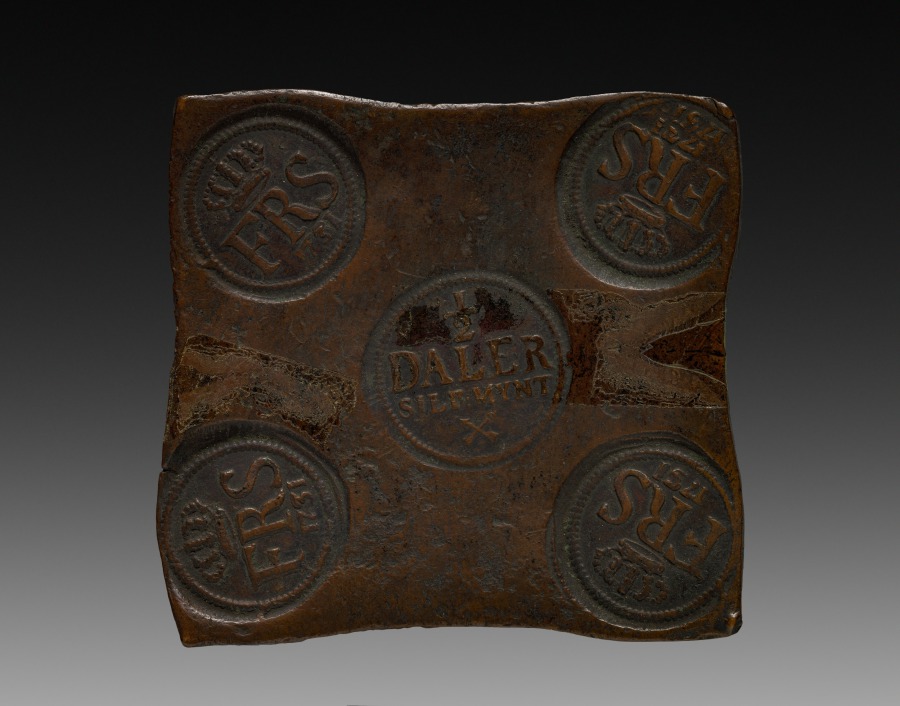
Open on the mapFrom 1644 Sweden struck copper plates as money, valued in daler silvermynt. The first plates, of 10 daler, weighed 19.7 kg and mostly went abroad. From 1649 smaller plates of 1 to 8 daler served in trade at home. Because the plates were costly to carry, they could stand at a discount, and when copper prices rose they left the country.
State-issued
No one's debt
Base-metal coin
Claims and evidence
The first copper plates, minted in 1644, were of 10 daler silvermynt and weighed 19.7 kg; they were mainly exported, not used to pay in domestic trade. Minting resumed in 1649 with plates of 1, 2, 4 and 8 daler that could be used more effectively to pay at home. Supported Little disputed
“The first copper plates, minted in 1644, had the denomination 10 daler silvermynt and weighed 19.7 kg. These plates were mainly exported and not used as means of payment in domestic trade.”
Edvinsson, R., "The multiple currencies of Sweden-Finland 1534-1803", in Edvinsson, Jacobson and Waldenström (eds), Exchange rates, prices, and wages, 1277-2008 (Sveriges Riksbank, 2010), ch. 4, section 4.3.5, p. 162“The minting of copper plates was suspended in 1645, only to be resumed in 1649.88 From then on, copper plates were also minted in lower denominations (1, 2, 4 and 8 daler silvermynt) that could be used more effectively as means of payment in domestic trade.”
Edvinsson, R., "The multiple currencies of Sweden-Finland 1534-1803", in Edvinsson, Jacobson and Waldenström (eds), Exchange rates, prices, and wages, 1277-2008 (Sveriges Riksbank, 2010), ch. 4, section 4.3.5, p. 162
In the 18th century the high cost of carrying copper plates in payment put them at a discount; undervalued plates tended to be exported. Supported Little disputed
“in Sweden-Finland in the 18th century, the high cost of transporting copper plates as means of payment resulted in a discount (negative premium) on copper plates.”
Edvinsson, R., "The multiple currencies of Sweden-Finland 1534-1803", in Edvinsson, Jacobson and Waldenström (eds), Exchange rates, prices, and wages, 1277-2008 (Sveriges Riksbank, 2010), ch. 4, section 4.3.1, p. 154“Copper plate coins, which were of higher denominations, therefore tended to be driven out of circulation (exported) when undervalued due to high copper prices.”
Edvinsson, R., "The multiple currencies of Sweden-Finland 1534-1803", in Edvinsson, Jacobson and Waldenström (eds), Exchange rates, prices, and wages, 1277-2008 (Sveriges Riksbank, 2010), ch. 4, section 4.3.1, p. 154
Keep exploring
Same money
- Edo, 1708–1709: the Hōei ten-mon coin, refused despite threats, then abolished
- Sweden, 1716–1719: copper "emergency coins" worth 1 per cent of face
- Louisiana: 'Colonie Françoise' copper made legal tender, 1721-1727
- VOC copper duits at Batavia
- Commonwealth, 1659–67: copper shillings and tymf złotys struck for army pay, then shut down
Same region, same era
- Stockholms Banco notes
- Lapland, to 1640: the Birkarls' trade monopoly, crown skin rates and fixed fairs
- Sámi fur tribute
- Sámi: coin taken by weight, silver buried, wealth in reindeer
- Hamburger Bank (mark banco)