Money in Sweden
Pengar i Sverige
Entries placed by today's borders.
Entries 13, in 2 eras
Span 850–1935
Kinds of money Silver by weight 5, Reindeer 3, Squirrel skins 2, Silver coin 2, Base-metal coin 2, and 10 others
W ithin present-day Sweden, the atlas places 13 entries, by their main place or a dated one, from 850 to 1935. The oldest is Viking-Age weighed silver: balance weights at Birka and Hedeby, and ring money (850–1066); the most recent, The 1870s shift from silver to gold (1871–1935). The money named most often is Silver by weight, in 5 entries.
The word for money
- Swedish pengar: plural of penning 'penny', the smallest (originally the only native) coin. Hellquist, E., Svensk etymologisk ordbok (Lund, 1922), s.v. pänning More on the word for money →
Middle period 500–1499
4 entries, 850–1674


Such Schmelzkugeln have also been found at other sites in Birka (the Black Earth), Hedeby and Sigtuna.Maleszka, M., 'A Viking Age weight from Cleat, Westray, Orkney', Proceedings of the Society of Antiquaries of Scotland 133 (2003), 283-291
Hollow marks: entries elsewhere that share this era's money (Dirham, Silver penny, Squirrel skins).
List of entries (4, and 8 elsewhere)
- 1 Viking-Age weighed silver: balance weights at Birka and Hedeby, and ring money 850–1066
- 2 Gotland's weighed silver economy 860–1000
- 3 Sámi fur tribute 870–1674
- 4 Renovatio monetae: periodic re-coinage (today in Sweden) 1140–1364
Elsewhere
- a Fur money in Rus' and Muscovy Kiev, 859
- b Genoa's coinage and the gold genovino Genoa, 1139
- c Hungary, 1130s–1336: a new penny every year at a 50% fee, then a hearth tax in its place Kingdom of Hungary, 1131
- d Viking-Age Denmark: silver paid by weight, hoards cut to øre units Denmark, 900
- e Bulghar, c. 903–922: marten skins as dirhams Bulghar, 903
- f Truso (Janów Pomorski), 9th century: cut dirhams weighed on scales Janów Pomorski, 815
- g Normandy: monetagium, a hearth tax paid so the duke would not change the coin Duchy of Normandy, 1100
- h Greater Poland, from 1181: bracteates in Hebrew letters struck by the duke's creditors Gniezno, 1181
Early modern 1500–1899
9 entries, 1528–1935
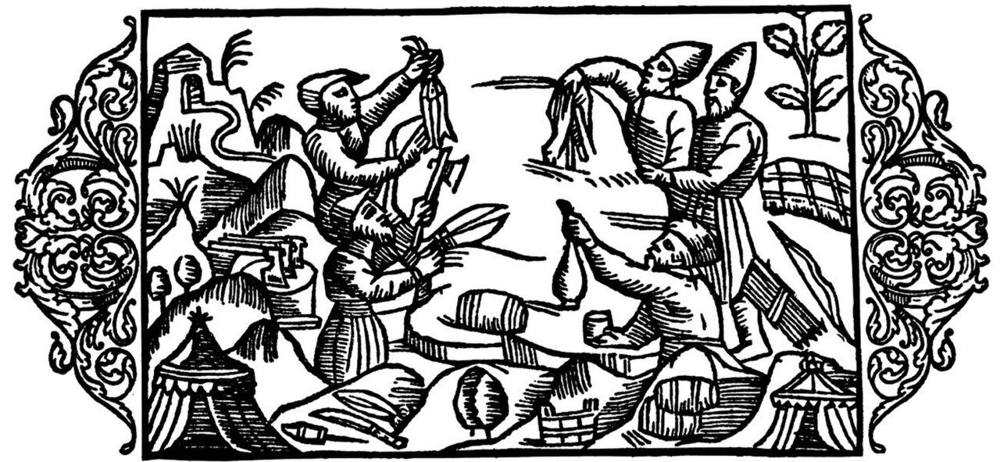


monopolizing the whole trade to themfelves, did not give them mony for their commodities, but fuch other merchandife, as their Country stood in need of.Johannes Schefferus, The History of Lapland (Oxford 1674; English translation of Lapponia, Frankfurt 1673), ch. XIV 'Of the Laplanders Fairs, and Customs in Trading', p. 78 (Runeberg page 0082)
Hollow marks: entries elsewhere that share this era's money (Squirrel skins) or that its sources name; the 2 farthest are listed below, not drawn.
List of entries (9, and 8 elsewhere)
- 1 Lapland, to 1640: the Birkarls' trade monopoly, crown skin rates and fixed fairs 1528–1673
- 2 Sámi: coin taken by weight, silver buried, wealth in reindeer 1555–1767
- 3 Sweden, 1590–1593: debased marks refused, prices decreed, traders unwilling 1590–1594
- 4 Sweden, 1644–1776: copper plate money, too heavy to carry 1644–1776
- 5 Stockholms Banco notes 1661–1668
- 6 Sámi: ruhta, money, once the bride-price in silver and reindeer 1673–1887
- 7 Sweden, 1716–1719: copper "emergency coins" worth 1 per cent of face 1716–1724
- 8 Swedish enskilda bank notes 1831–1903
- 9 The 1870s shift from silver to gold (today in Sweden) 1871–1935
Elsewhere
- a Classical gold standard London, 1871
- b The 1870s shift from silver to gold Denmark 1872
- c The 1870s shift from silver to gold Norway 1875
- d The 1870s shift from silver to gold Netherlands 1875
- e The 1870s shift from silver to gold Paris 1876
- f Finland: raha, the word for money, first meant a fur Finland, 1642
- Silver against gold, 1871–1935: what silver money lost in India and China India, 1871
- The 1870s shift from silver to gold India 1893
What this cannot show
- How much money of each kind was in use: the marks count entries, not coins, notes or goods.
- A census: the atlas seeks out money made without a state, so an era with few entries is not an era with little money.
- The past's borders: entries are placed by today's, and the same money often ran beyond them; see the map.
Sources quoted on this page
- Maleszka, M., 'A Viking Age weight from Cleat, Westray, Orkney', Proceedings of the Society of Antiquaries of Scotland 133 (2003), 283-291
- Johannes Schefferus, The History of Lapland (Oxford 1674; English translation of Lapponia, Frankfurt 1673)