Money and barter in the Americas
Before and after European contact
In this atlas the written record of money in the Americas begins with European contact: no entry quotes a text from before it about buying, selling or paying. What is known of earlier times rests on archaeology and on what the first writers reported. Of 263 entries, 2 end before contact in their region, 19 span it and 242 begin after it.
Where the entries are
Skip the map| Region | Year | Before | At | After |
|---|---|---|---|---|
| GreenlandNorse settlement of Greenland | 985 | 0 | 0 | 3 |
| Alaska and ArcticBering and Chirikov reach Alaska | 1741 | 0 | 0 | 12 |
| Pacific NorthwestJuan Pérez reaches Haida Gwaii / Nootka coast | 1774 | 0 | 0 | 7 |
| California and Great BasinCabrillo voyage along the California coast | 1542 | 0 | 1 | 7 |
| Southwest and northern MexicoCabeza de Vaca party lands | 1528 | 0 | 0 | 9 |
| Plains and interior North AmericaCoronado reaches the Plains | 1541 | 0 | 0 | 15 |
| Southeast (US)Ponce de León in Florida | 1513 | 0 | 0 | 23 |
| Northeast and Great LakesJohn Cabot on the North Atlantic coast | 1497 | 0 | 0 | 55 |
| CaribbeanColumbus in the Bahamas, Cuba and Hispaniola | 1492 | 0 | 2 | 22 |
| MexicoCortés lands at Veracruz | 1519 | 0 | 8 | 5 |
| Yucatán and Central AmericaColumbus on the Honduras coast | 1502 | 1 | 2 | 11 |
| Northern South AmericaColumbus on the Venezuelan coast | 1498 | 0 | 0 | 18 |
| Andes and Pacific South AmericaRuiz meets a Tumbes raft off Ecuador | 1526 | 1 | 5 | 10 |
| Brazil and AmazoniaCabral on the Brazilian coast | 1500 | 0 | 1 | 18 |
| Río de la Plata and PatagoniaSolís in the Río de la Plata | 1516 | 0 | 0 | 27 |
| All regions | 2 | 19 | 242 |
All 263 entries, region by region
Greenland
- West Greenland: barter as trade and as a game 1721–1736 · after
- Royal Greenland Trade: fixed prices and its own notes 1774–1877 · after
- Baffin Island: bearskins for the whalers 1883–1884 · after
Alaska and Arctic
- Coppermine river: copper for iron 1771 · after
- Russian-American Company skin and parchment scrip ('leather money') 1816–1867 · after
- Upper Yukon: a gun for its height in furs 1848–1852 · after
- Norton Sound and the Yukon: prices in musket-balls and tobacco 1866–1868 · after
- Bering Strait skin unit of value 1867–1881 · after
- Norton Sound: the Asking festival 1877–1881 · after
- Point Barrow: bear meat divided, whalebone bought up 1881–1883 · after
- Camp Clay, 1883–84: ration trading, then a ban 1883–1884 · after
- Klondike gold dust 1897–1898 · after
- Nome and Council City: gold dust at $16 an ounce 1900–1901 · after
- Colville and Point Barrow Inuit: fish piles shared, dance gifts repaid 1906–1912 · after
- Copper Inuit: food shared by rule, other things lent, given back or bartered 1914–1916 · after
Pacific Northwest
- Nootka Sound, 1778: nothing but metal 1778 · after
- Northern Northwest Coast: sea-otter skin, then the blanket 1785–1887 · after
- Glass beads on the Lower Columbia 1805–1806 · after
- Fort Okanagan: skins sorted into lots 1813–1817 · after
- Kwakwaka'wakw blankets and coppers 1849–1897 · after
- LETS 'green dollars' (Comox Valley) 1983–1984 · after
- Idaho: gold and silver, untaxed and then legal tender 1984–2026 · after
California and Great Basin
- Chumash shell beads: money, and how old? 0–1792 · at
- Dentalium shell money 1814–1925 · after
- Alta California: hides as 'California bank notes' 1835 · after
- California gold dust and private mints 1848–1855 · after
- Comstock: gold and silver coin, greenbacks at a discount 1862–1876 · after
- Clamshell disc-bead money (Pomo and southern California) 1871–1925 · after
- Obsidian blades of northwestern California: wealth, and money? 1872–1925 · after
- Linden dollars (Second Life) 2006–2011 · after
Southwest and northern Mexico
- Texas, c.1530: a go-between carrying shells inland 1529–1536 · after
- Northern Mexico, 1535: gifts and ritual plunder 1535–1536 · after
- Cíbola, 1539: turquoise and hides for labour (reported) 1539 · after
- Cedros Island, 1540: fish for beads, seal-skins taken and ordered restored 1540 · after
- Plains hides for Pueblo corn and cloth 1541–1583 · after
- New Mexico: pesos de la tierra 1767–1788 · after
- The Mojave, 1776: white sea-shells, the good taken in exchange 1776 · after
- The Pueblos, 1880–85: shell beads and turquoise beside coin 1880–1885 · after
- Arizona: no state tax on gains from gold and silver coin 2018–2026 · after
Plains and interior North America
- Horses as standard of value on the Plains 1750–1880 · after
- Athabasca: the fur-trade credit cycle 1787–1793 · after
- Knife River villages: horses priced in guns and beaver skins 1804–1806 · after
- Shoshone: horses for a coat and knives 1805 · after
- Buffalo robes as money 1830–1880 · after
- Green River rendezvous: trappers on credit 1833 · after
- Green River rendezvous: beaver against dollar prices 1836–1837 · after
- Hudson's Bay Company notes 1849–1894 · after
- Denver: gold dust and Clark, Gruber coin 1859–1860 · after
- Montana: gold dust as the only money 1863–1865 · after
- US stamp scrip, 1932-34 1932–1934 · after
- Bitcoin's first exchange rate (New Liberty Standard) 2009–2010 · after
- Utah: gold and silver coin as legal tender (2011) 2011–2026 · after
- Wyoming: gold and silver specie as legal tender 2018–2026 · after
- Custodia Bank (Wyoming SPDI) 2020–2026 · after
Southeast (US)
- Cofitachequi, 1540: pearls with the dead 1540 · after
- Cayas, 1541: salt carried off to trade 1541 · after
- Calusa, c. 1549–66: tribute to the chief, and silver from wrecks 1549–1566 · after
- Shell and glass beads in the Southeast 1700–1775 · after
- Deerskins as unit of value 1733–1775 · after
- Natchitoches: trade goods on credit, repaid in skins at fixed rates 1770 · after
- Augusta, 1773: trade debts paid in land 1773 · after
- Seminole credit at Spalding's store 1774 · after
- Seminole canoe trade with Cuba 1774 · after
- Comanche mule trade on the Canadian River 1839 · after
- Andersonville: uniform buttons as prices 1864 · after
- US scrip acts: wages in money, not store orders 1881–1967 · after
- Coal-company scrip (Stearns Coal and Lumber, Big South Fork) 1902–1947 · after
- Jekyll Island meeting 1910 · after
- Bank runs of 1930-33 and the 1933 bank holiday 1930–1933 · after
- e-gold 1996–2008 · after
- Liberty Dollar (NORFED) 1998–2011 · after
- Bitcoin's first priced purchase 2010 · after
- Oklahoma: gold and silver coin as legal tender 2014–2026 · after
- Arkansas: gold and silver coin as legal tender 2023–2026 · after
- Louisiana: gold and silver as legal tender 2024–2026 · after
- Florida: gold and silver coin as legal tender for debts 2026 · after
- Texas: privately minted gold and silver as legal tender 2026 · after
Northeast and Great Lakes
- New England coast, 1524: copper over gold, trade by cord 1524 · after
- Chaleur Bay, 1534: skins for iron 1534 · after
- Hochelaga, 1535: shell beads used as gold and silver 1535 · after
- Wampum 1600–1700 · after
- Virginia: peak and roenoke shell money 1607–1705 · after
- Tobacco as currency in colonial Virginia 1616–1699 · after
- Huron reparation for a murder, 1648 1648 · after
- Quebec, 1674: moose skins made legal tender 1674 · after
- Made Beaver: Hudson's Bay unit of account 1678–1908 · after
- Albany, 1684: beaver skins as tokens and satisfaction 1684–1712 · after
- Montreal: beaver trade and the canoe licences 1684–1686 · after
- Card money of New France 1685–1719 · after
- Albany against Montreal: the price of beaver 1724–1737 · after
- Massachusetts Land Bank 1740–1741 · after
- Upper Ohio frontier: 'fur and peltry were the people's money' 1763–1783 · after
- Britain's Currency Act of 1764 1764 · after
- Continental currency 1775–1781 · after
- US federal law on gold, silver and bitcoin as money 1789–2026 · after
- First Bank of the United States (1791-1811) 1791–1811 · after
- US bimetallism: gold leaves circulation, 1792-1834 1792–1834 · after
- US dollar 1792–2026 · after
- Bank suspensions of specie payment (1814; 1837; 1857) 1814–1857 · after
- Panic of 1819 1815–1822 · after
- US trading factories that would not give credit 1815–1816 · after
- Second Bank of the United States (1816-36) and Jackson's Bank War 1816–1836 · after
- Josiah Warren's labor notes (Cincinnati and Utopia) 1827–1848 · after
- Specie Circular (1836): gold, silver or Virginia land scrip 1836 · after
- 1837 'shinplasters' (private small notes) 1837–1839 · after
- US free-bank and 'wildcat' notes 1837–1863 · after
- Canadian chartered-bank notes 1850–1944 · after
- Clearinghouse loan certificates (1857-1914) 1857–1914 · after
- US Civil War tokens 1861–1864 · after
- Greenbacks 1862–1879 · after
- National Banking Acts (1863-64) and 10% tax on state bank notes (1865) 1863–1913 · after
- Coinage Act of 1873 ('Crime of '73') 1873 · after
- Panic of 1873 1873–1879 · after
- Labrador: the truck system 1892–1918 · after
- Panic of 1893 1893–1897 · after
- Bryan's 'Cross of Gold' (1896) and the Gold Standard Act (1900) 1896–1900 · after
- Panic of 1907: Knickerbocker Trust and J.P. Morgan's rescue 1907–1908 · after
- Labrador: pelts priced in money 1910 · after
- Federal Reserve Act 1913–2026 · after
- Chicago Plan for 100% reserve money 1933–1935 · after
- Executive Order 6102 (1933): gold surrender 1933–1974 · after
- FDIC and the Banking Act of 1933 1933–2026 · after
- Bankhead-Pettengill stamp scrip bill (1933) 1933 · after
- Bretton Woods 1944–1971 · after
- Rothbard, The Case for a 100 Percent Gold Dollar (1962) 1962–1996 · after
- Gold window closed 1971 · after
- Ithaca HOURS 1991–1998 · after
- BerkShares 2006–2015 · after
- The Narrow Bank (TNB USA Inc.) 2017–2020 · after
- Missouri: the Constitutional Money Act 2025–2026 · after
- United States: ban on a retail central bank digital currency 2025–2026 · after
- The GENIUS Act: rules for dollar payment stablecoins 2025–2026 · after
Caribbean
- Guanahani, 1492: cotton for scraps 1492–1493 · at
- Hispaniola: guanín, a gold alloy held as wealth 1492–1498 · at
- Trinidad 1595: tobacco for canoes, and a Spanish ban on trade 1595 · after
- Bermuda 'hogge mony' 1616–1624 · after
- Bermuda: tobacco as pay and money 1620–1684 · after
- Barbados: muscovado sugar as money 1631–1715 · after
- Kalinago caracolis: metal crescents as top wealth 1642–1665 · after
- Grenada 1650: the island ceded to the French for trade goods 1650 · after
- Barbados: proclaimed coin rates, clipped silver and the 1704 drain 1651–1825 · after
- Buccaneer and pirate articles: shares paid in pieces of eight 1666–1724 · after
- Buccaneers' spending and tavern credit in Jamaica and Tortuga 1666–1672 · after
- Bahamas: wrecks, pirates and the pieces of eight they spent 1691–1718 · after
- Barbados paper credit of 1705-1706 1705–1707 · after
- Barbados: 1708 ban on enslaved people selling and bartering 1708 · after
- Bahamas: legal rates for foreign gold, 1744–1788 1744–1788 · after
- Spanish Trinidad: forced treasury notes and a doubloon rated by weight 1783–1797 · after
- Grenada: cut bits and plugged joes stamped 'G' 1787–1838 · after
- Tobago: plugged joes, stamped 'estampees' and cut dollars 1798–1838 · after
- Trinidad: holed dollars and the 'T Bit' 1804–1857 · after
- Cuba: the informal dollar rate, private dollars and crypto 2018–2026 · after
- Cuba: the peso, the end of the CUC and state dollarisation 2019–2025 · after
- The Sand Dollar: The Bahamas' central bank digital currency 2020–2025 · after
- DCash: the Eastern Caribbean digital currency pilot 2021–2026 · after
- JAM-DEX: Jamaica's central bank digital currency 2022–2026 · after
Mexico
- Copper axe-monies of West Mexico 1200–1550 · at
- Cacao beans 1300–1637 · at
- Cotton mantles (quachtli) 1400–1560 · at
- Mexica loans, pledges and interest 1428–1565 · at
- Greenstone (chalchihuitl) in central Mexico: treasure and payment 1430–1521 · at
- Spanish dollar (piece of eight) as world money 1497–1857 · at
- Gold dust in quills (Tlatelolco) 1519 · at
- Moctezuma's tribute and its account books 1519–1520 · at
- Magdalena Bay, 1539: pearl shells and feathers left for beads on a rock 1539 · after
- The Manila galleon, 1593–1815: the crown's cap on silver (permiso) 1593–1815 · after
- Acapulco and Manila, 1593–1767: silver shipped beyond the cap 1593–1767 · after
- Northern Mexico: raw bar silver (plata pasta) below the mint price 1810–1827 · after
- Mexico, before 1867: soap in the towns and eggs in the country as small change 1867 · after
Yucatán and Central America
- Calakmul murals: goods shown, money left open 620–700 · before
- Maya stone and shell beads as money 1500–1566 · at
- Verapaz: quetzal feathers used as money, the bird protected by law 1500–1545 · at
- Isthmus of Panama: the Cueva, trade without money 1513–1530 · after
- El Salvador's money 1524–2026 · after
- Nicaragua, 1520s: cacao as money in the tiangüez 1527–1529 · after
- Kingdom of Guatemala: cacao as current money, 1546–c. 1690 1546–1690 · after
- Portobelo fair, 1637: silver wedges by weight 1637 · after
- Darien, 1681: buccaneers pay their Indian guides in goods 1681 · after
- Costa Rica: cacao as money, 1687–1738 1687–1738 · after
- Indigo in colonial El Salvador: sold for silver, owed on credit 1758–1821 · after
- Panama, 1904: the gold balboa and US gold as legal tender 1904 · after
- Guatemala, 1924: the gold quetzal replaces the peso 1924 · after
- El Salvador: bitcoin as legal tender 2021–2026 · after
Northern South America
- Quiripa shell-bead currency 1550–1800 · after
- Muisca gold tejuelos and salt cakes 1573–1578 · after
- Guiana: green stones as Carib money 1596–1844 · after
- Santafé de Bogotá mint (Casa de Moneda, 1620) 1620–1982 · after
- Coastal Guiana Arawak: lending without care for payment 1800–1917 · after
- Macuquina: cut silver at Caracas 1803–1841 · after
- Venezuela's paper money of 1811 1811–1812 · after
- Republican pesetas of Caracas and the Barinas coin 1813–1818 · after
- The venezolano and the silver bolívar 1871–1879 · after
- Guiana: debt tallies of knotted string 1877–1883 · after
- Colombian paper money and inflation in the Thousand Days' War (1899-1902) 1899–1903 · after
- Trio and Wayana: present for present 1904–1905 · after
- Taulipáng and Makuschí: food shared, barter on long credit 1911–1913 · after
- Yekuana: the elder shares out the catch 1912 · after
- Venezuela: de facto dollarisation, USDT and three bolívar redenominations 2008–2025 · after
- Venezuela: rents in dollars, banned 2011, allowed 2026 2011–2026 · after
- The petro: Venezuela's state crypto-asset 2018–2024 · after
- Tumeremo: gold flakes as everyday money 2021 · after
Andes and Pacific South America
- Spondylus (mullu) in the Andes 2500 BC–1621 · at
- Ecuadorian copper axe-monies 900–1532 · at
- Sicán naipes 900–1100 · before
- Quipu accounting 1400–1572 · at
- Copper money of the Chincha 1400–1532 · at
- Inca Peru: no buying or selling, by Garcilaso's account 1400–1532 · at
- Coca leaf as money 1530–1570 · after
- Potosí silver and its mint: cob coins behind the Spanish dollar 1545–1789 · after
- Cuzco, 1550s: barter in a colonial market without coin 1550–1560 · after
- Potosí mint fraud and debasement (1649) 1620–1652 · after
- Mapuche 'payments': barter priced in a unit 1776–1787 · after
- Chiloé: tobacco above money 1791–1834 · after
- Chile: nitrate fichas and the pulpería 1901–1924 · after
- Bolivian tin mines: food below cost as part of wages 1940–1943 · after
- Bolivia: bitcoin banned, then allowed 2014–2026 · after
- Ecuador: the central bank's electronic money 2018 · after
Brazil and Amazonia
- Porto Seguro, 1500: bows for caps 1500 · at
- Guanabara Bay, 1519: chickens for a fishhook 1519 · after
- Santa Catarina, 1526–27: deer for a wedge and a hook, and a debt in fish-hooks 1526–1527 · after
- Amazon, 1544–46: nothing taken without payment, by royal order 1544–1546 · after
- Tupi coast, 1550s: feathers as treasure, no money 1553–1555 · after
- Ouetaca: exchange at a distance, as Léry heard it 1557 · after
- Brazil: sugar made money by decree 1614–1694 · after
- Asháninka salt money (Cerro de la Sal) 1635–2002 · after
- Cotton cloth money in colonial Amazonia 1650–1750 · after
- Minas Gerais: gold dust as the only money 1695–1711 · after
- Forest produce as 'natural money' 1700–1750 · after
- Amazon rubber camps: aviamento credit without cash 1870–1945 · after
- Upper Xingu: catch shared house by house, guest-gifts between tribes 1884–1888 · after
- Bororo: game shared out, not traded 1888 · after
- Siusí (Baniwa): the chief shares out the catch, debts paid months later 1903–1905 · after
- Kobéua: bought now, paid for later 1904–1905 · after
- North-west Amazon: barter and gifts between tribes 1908–1909 · after
- Canela: valuables passed on as obligatory fees 1929–1936 · after
- Banco Palmas and the palma social currency 1998–2025 · after
Río de la Plata and Patagonia
- San Julián, 1520: gifts, and a guanaco 1520 · after
- Paraná, 1527–28: gold and silver plates passed on for beads and canoes 1527–1528 · after
- Contact on the Paraná and Paraguay: provisions paid in knives, wedges and fish-hooks 1536–1544 · after
- Guaycurú and Guaraní: a two-day river market at Asunción, 1542 1542–1543 · after
- Asunción's 'moneda de la tierra': wedges, then cotton, tobacco and yerba at legal values 1544–1793 · after
- Guaraní mission towns without money; yerba as currency 1609–1767 · after
- Abipones: the cacique gives whatever is asked 1750–1767 · after
- Francia's Paraguay: licensed trade at Itapúa and a return to exchange 1819–1825 · after
- Buenos Aires paper peso 1822–1867 · after
- Tierra del Fuego: a nail for two fish 1834 · after
- Tucumán notes of 1840 1840 · after
- Bolivian silver in the Argentine interior 1840–1881 · after
- López's Paraguay: copper coins, state paper and war depreciation 1847–1869 · after
- Patagones: Tehuelche barter, rations and beaten dollars 1869–1870 · after
- Argentina's coinage law of 1881 1881 · after
- Lengua (Enxet): no one to have more than his neighbour 1889–1910 · after
- Caja de Conversión: Argentina's first currency board 1891–1935 · after
- Choroti and Ashluslay: one day giving, the next receiving 1908–1909 · after
- Argentina's currency replacements, 1970-1992 1970–1992 · after
- Argentina: homes priced and paid in dollars (from 1977) 1977–2026 · after
- Plan Bonex: deposits repaid in bonds 1990 · after
- Argentina's convertibility system 1991–2002 · after
- Argentine trueque and the crédito 1995–2002 · after
- Argentina's quasi-monies, 2001-2002 2001–2002 · after
- Argentina: the blue dollar under the cepo 2011–2025 · after
- Argentina: UVI and UVA, mortgage units paid in pesos (2016) 2016–2026 · after
- Decree 70/2023: debts in the agreed currency 2023 · after
Before contact
The record is of objects, and of later writers looking back. How far each counts as money is argued, entry by entry.
- Andean spondylus. Thorny-oyster shell was traded long-distance as a valuable from the 3rd millennium BC. A vessel met at sea about 1526 carried silver, gold and cloth:
Todo esto traian para rescatar por unas conchas de pescado de que ellos hacen cuentas coloradas como corales, y blancas, que traian casi el navio cargado de ellas.
(All this they carried to trade for some sea shells from which they make beads red like coral, and white, and they had the vessel almost loaded with them.) Anonymous relation to Charles V (c. 1527), printed in Saville (1907), p. 280 Reading these shells as spondylus is an inference. - Sicán naipes. Shimada argued that these standardised copper pieces, found in bundled packets of up to 500, were a form of primitive money.
- Ecuadorian axe-monies. Thin copper plates, hoarded in thousands and bundled in packets of 20. Holm found weight clusters on a quinary system and argued they meet the requirements of primitive money.
- West Mexican copper axes. Standardised in size and weight, and concluded by Hosler and colleagues to have served with cacao and mantles as a medium of exchange.
- Cacao. Beans served as small change in Mesoamerica, and Spanish observers recorded prices in them.
- Cotton mantles. Rojas argues that standard mantles were the higher denomination of Aztec money, worth 65, 80 or 100 cacao beans.
- Chumash shell beads. Lynn Gamble argues, as her university reported, that people on this coast
were using highly worked shells as currency as long as 2,000 years ago
J. Logan, 'An Ancient Economy', UC Santa Barbara news (28 January 2021), reporting L. Gamble, 'The origin and use of shell bead money in California', Journal of Anthropological Archaeology 60 (2020), news release That date is her interpretation of bead finds, not a record of payment.
Goods could travel far with no evidence of money: nothing links the cacao found at Pueblo Bonito in Chaco Canyon to payment, though Crown and Hurst find that its residue indicates exchange with cacao cultivators in Mesoamerica in a time frame of about A.D. 1000–1125
. P. L. Crown and W. J. Hurst, 'Evidence of cacao use in the Prehispanic American Southwest', PNAS 106 (2009), abstract
States without state money
The Mexica took goods that also passed as money. Cotton mantles were paid as fines and tribute, and Bernal Díaz says of Moctezuma: not only did he take tribute from nearly all parts of New Spain,
Díaz, transl. Maudslay, vol. 2, vol. 2 The entries show these goods being collected. They do not show the state creating them.
Of the Inca, Garcilaso writes: They exchanged one article of food for another, and no more
Garcilaso de la Vega, First Part of the Royal Commentaries of the Yncas, trans. C. R. Markham, vol. 2 (Hakluyt Society, 1869-71), Bk VI ch. 8 He wrote in Spain decades later, from memory and family tradition, and he idealises the Inca state (the entry). Gold was prized and held in great quantity by rulers and temples, but none of these sources shows it buying anything before the conquest. Acosta dates that change: Después que entraron Españoles, usaron también los Indios el oro y plata para comprar
(After the Spaniards came in, the Indians also used gold and silver to buy) José de Acosta, Historia natural y moral de las Indias (1590), ed. Madrid 1894, vol. 1, book IV, ch. 3, p. 295 Another source differs on the wider picture: an anonymous account says the Chincha merchants alone in the Inca realm dealt in money, buying food and clothing with copper.
No entry in the atlas records a pre-contact state issuing money or forcing its acceptance. None of the 2 entries before contact carries the atlas's mark for money issued or imposed. Of the 19 at contact, 2 do: the Spanish dollar, a European coin, and Moctezuma's tribute, which records goods taken, not money issued. This is a statement about the record, which is thin. Rosenswig argues the other way, that cacao, cloth and beads were currencies of taxation and that Maya governments used tally sticks as monetary devices; the atlas reports both as his arguments, and they are disputed.
At contact: the first meetings
Most of these first accounts describe goods swapped for goods.
- Guanahani, 1492. Columbus:
they give away all they have got, for whatever may be given to them, down to broken bits of crockery and glass
The Journal of Christopher Columbus (during his first voyage, 1492-93), trans. C. R. Markham (Hakluyt Society, 1893) - Porto Seguro, 1500. Caminha:
Davam nos d'aqueles arcos e seetas por sombreiros e carapuças de linho
(They gave us some of those bows and arrows for hats and linen caps) Pero Vaz de Caminha, letter to King Manuel (1 May 1500), ed. Instituto Geographico e Historico da Bahia (Bahia, 1900), letter of 1 May 1500 - New England coast, 1524. Verrazzano met people who traded from the rocks, by a cord:
they took from us only knives, fish hooks and sharpened steel.
Giovanni da Verrazzano, letter to Francis I (1524), in Winship (1905), northern coast section - Chaleur Bay, 1534. Cartier:
making us signs that they would come to traffic with us, and showing us some skins of little value
Jacques Cartier, First Voyage (1534), in J. P. Baxter, A Memoir of Jacques Cartier (New York, 1906), First Voyage, July 1534 - The Cueva of the Isthmus. Oviedo:
É todas estas cosas é otras se dan unas á trueco de otras, porque no tienen moneda ni çierto presçio
(And all these things and others are given one in exchange for another, because they have no money nor fixed price) G. Fernández de Oviedo, Historia general y natural de las Indias, ed. J. Amador de los Ríos (Madrid, 1851-55), tomo III, lib. XXIX, cap. XXVIII, p. 140 - Nicaragua's cacao markets. Here cacao passed as money. Asked about 1528 whether any law set prices, Indigenous witnesses answered:
No, sino la voluntad de los dos que contractan, é assi lo barata é vende cada uno lo mejor quél puede
(No, only the will of the two who deal, and so each bargains and sells as best he can) G. Fernández de Oviedo, Historia general y natural de las Indias, ed. J. Amador de los Ríos (Madrid, 1851-55), tomo IV, inquiry of Fray Francisco de Bobadilla (c. 1528), lib. XLII, cap. III, p. 54 - Texas, about 1530. Cabeza de Vaca carried shells and beads inland for hides, ochre and flint, and saw that
other Indians from beyond come to them with bows for barter and exchange
Alvar Núñez Cabeza de Vaca, Relación (1542), transl. F. Bandelier (New York, 1905), pp. 80-81 - Nootka Sound, 1778. Cook:
Nothing would go down with our visiters but metal; and brass had, by this time, supplanted iron
James Cook, in J. Cook and J. King, A Voyage to the Pacific Ocean, vol. II (London, 1784), vol. II, p. 279, April 1778 This is a demand for one material; it does not show metal serving as money among the people of the Sound.
The words
The etymology of money gathers 58 words from 50 Indigenous languages. 13 come from shells or beads and 21 from metals. 12 are borrowed, 9 from Spanish and 3 from English. Sources place only 4 before contact, and 41 cannot be dated. For 6 peoples, writers said there was no money or no use of it, which is not the same as saying they had no word for it.
After contact
Among the 242 entries after contact, 44 are money with no state role recorded; 30 are marked state-issued, 25 imposed and 39 under state licence or control. Each of the examples below carries the atlas's own mark.
Arose in use
- Wampum 1600–1700 Adopted by a state, not issued by it

Detail of a black Indian girdle "made of wampum peek, the best sort, 1656". Dark and white wampum (shell) beads on leather cords, from… — Ian Alexander, CC BY-SA 4.0 the white with them is as silver with us, the other as our gould, and for these beads they buy and sell, not only amongst themselves, but even with us.
Thomas Morton, New English Canaan (1632), quoted in W. H. Holmes, Art in Shell of the Ancient Americans, BAE 2nd Annual Report (1883), Holmes 1883, 'Beads as currency' Colonial governments later set its rates. - Tobacco as currency in colonial Virginia 1616–1699 No state role recorded
It arose in use before any law recognised it:The universal use into which tobacco came as currency, arose, not from the preference of the settlers, but by the force of circumstances which they could not have controlled even if they had wished to.
Bruce, Philip Alexander. 1896. Economic History of Virginia in the Seventeenth Century, vol. 2, ch. 'Money'. New York: Macmillan. - Costa Rica: cacao as money, 1687–1738 1687–1738 No state role recorded
Cacao went on serving as money under Spanish rule. At Nicoya in 1687:y que la poca moneda que hay es cacao
(and that the little money there is, is cacao) L. Fernández (comp.), Colección de documentos para la historia de Costa Rica, vol. 8 (Barcelona, 1907): inquiry at the request of the Indians of Nicoya, 1687, vol. 8, p. 473
Issued, imposed or controlled
- Asunción's 'moneda de la tierra': wedges, then cotton, tobacco and yerba at legal values 1544–1793 Imposed
The crown and courts set the values at which goods paid debts. Debtors paid in the lowest-valued goods, and the peso sank:pues el peso no ha excedido del valor de dos reales de plata que es la tercia parte de los seis reales de la Ley
(for the peso has not exceeded the value of two reales of silver, which is a third of the six reales of the Law) Eduardo R. Saguier, Un debate histórico inconcluso, tomo XIII, cap. 4: 'La Crisis Agraria. La Economía de Trueque del Litoral Rioplatense', citing Burzio 1958, Garavaglia 1983 and AGN Buenos Aires, same section, quoting an AGN expediente (n. 17) - Quebec, 1674: moose skins made legal tender 1674 Imposed
Le conseil a ordonné et ordonne que les peaux d’orignal auront cours au prix ordinaire; défenses à toutes personnes d’en faire refus.
(The Council ordained and ordains that moose skins shall be current at the ordinary value, with prohibition to every one to refuse them.) A. Shortt (ed.), Documents relating to Canadian Currency, Exchange and Finance during the French Period, vol. 1 (Ottawa, 1925), Arrêt du Conseil Supérieur, 27 Sept. 1674, Shortt vol. 1 - Potosí silver and its mint: cob coins behind the Spanish dollar 1545–1789 State-issued
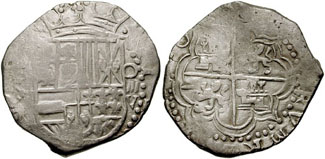
Silver cob 8 reales of Philip II, Potosi mint, c. 1580 — User:LouisAragon (uploader), CC BY-SA 2.5 - Made Beaver: Hudson's Bay unit of account 1678–1908 Private, under state licence or control
The Hudson's Bay Company's unit of account. At the post the hunter's furs were valued andhe hands the Indian fifty or sixty little bits of wood in lieu of cash
Ballantyne, R. M., Hudson's Bay; or, Every-day Life in the Wilds of North America (1848), ch. III, ch. III - Coal-company scrip (Stearns Coal and Lumber, Big South Fork) 1902–1947 Imposed
Forced by the coal companies, not the state:Usually, there is stated on the scrip: "Nonnegotiable—Payable in Merchandise Only."
U.S. Department of the Interior, Coal Mines Administration, A Medical Survey of the Bituminous-Coal Industry (Washington, 1947) ['Boone report'], p. 217
What this cannot show
- The evidence before contact is thin. Only 2 of 263 entries end before contact, and much of the early evidence is objects whose use has to be inferred. Holmes put the difficulty in 1883:
It will probably be impossible to prove that the prehistoric peoples of North America employed a medium of exchange in a manner corresponding to our use of money.
Holmes, Art in Shell of the Ancient Americans (1883), 'Beads as currency', opening - The writers were mostly outsiders who came after. Most of the writers quoted here arrived with or after contact. Even the Indigenous witnesses of Nicaragua reach us through a Spanish inquiry.
- Some regions have nothing from the time of contact. In 9 of 15 regions no entry reaches back to it. The earliest entry in each is: Greenland (1721); Alaska and Arctic (1771); Pacific Northwest (1778); Southwest and northern Mexico (1529); Plains and interior North America (1750); Southeast (US) (1540); Northeast and Great Lakes (1524); Northern South America (1550); Río de la Plata and Patagonia (1520).
- Exchange is not the same as money. Goods moving between peoples, or a good that is highly valued, do not show that anything served as money. An empty region on the map means only that the atlas holds no entry there.
- The contact years are coarse. One date stands for a whole region, and first meetings often came decades before lasting contact.