Money in Australia
Entries placed by today's borders.
Entries 6, in 2 eras
Span 1788–1925
Kinds of money Barter, no money 2, Spirits 1, Private bank notes 1, Gold dust 1
W ithin present-day Australia, the atlas places 6 entries, by their main place or a dated one, from 1788 to 1925. The oldest is Rum as currency in early New South Wales (1788–1813); the most recent, Central Australia: ochre between tribes (1903–1925). The money named most often is Barter, no money, in 2 entries.
The word for money
- English money: Latin moneta 'mint', a surname of Juno in whose temple at Rome coin was struck dictionaries disagree. Skeat, W. W., An Etymological Dictionary of the English Language, new ed. (Oxford, 1898), s.v. MONEY More on the word for money →
Early modern 1500–1899
5 entries, 1788–1911
The colonists relied on the barter of produce, goods and services, and other makeshift currencies such as rum, as all spirits were then called.Reserve Bank of Australia Museum (n.d.). 'Crisis in the Colony of New South Wales', Pocket Guide to Australian Banknotes: Currency Crises.
What served as money share of 4 mentions
List of entries (5)
- 1 Rum as currency in early New South Wales 1788–1813
- 2 Australia, 1817–1910: private bank notes, forced legal tender in 1893, taxed out in 1910 1817–1911
- 3 Victoria goldfields: dust sold at the store 1852–1854
- 4 Arrernte: a fixed habit of giving 1875–1899
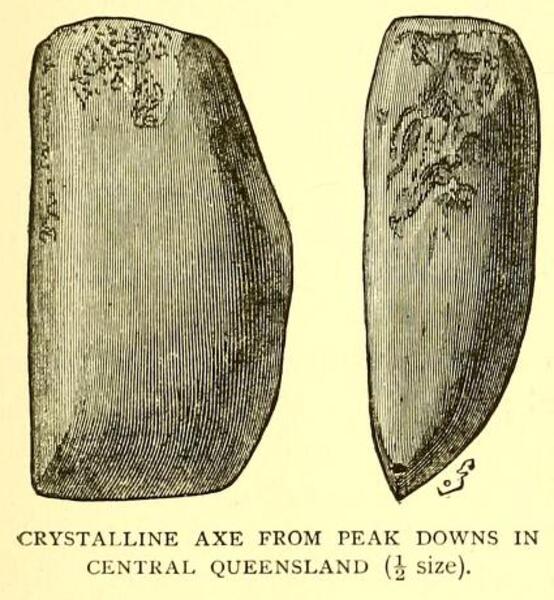
- 5 Queensland: barter for axe stone 1880–1884
Modern 1900 to today
1 entry, 1903–1925
Ochre and pipe-clay, which form an article for inter-tribal barter, are carried from one tribe to another in oblong parcels contained in bark wraps,Basedow, H., The Australian Aboriginal (1925), ch. XXVIII
List of entries (1)
- 1 Central Australia: ochre between tribes 1903–1925
What this cannot show
- How much money of each kind was in use: the marks count entries, not coins, notes or goods.
- A census: the atlas seeks out money made without a state, so an era with few entries is not an era with little money.
- The past's borders: entries are placed by today's, and the same money often ran beyond them; see the map.
Sources quoted on this page
- Reserve Bank of Australia Museum (n.d.). 'Crisis in the Colony of New South Wales', Pocket Guide to Australian Banknotes: Currency Crises.
- Basedow, H., The Australian Aboriginal (1925), ch. XXVIII