Money in Bolivia
El dinero en Bolivia
Entries placed by today's borders.
Entries 8, in 3 eras
Span 1497–2026
Kinds of money Spanish dollar 3, Silver by weight 1, Other commodity 1, Cloth 1, Private bank notes 1, and 2 others
W ithin present-day Bolivia, the atlas places 8 entries, by their main place or a dated one, from 1497 to 2026. The oldest is Spanish dollar (piece of eight) as world money (1497–1857); the most recent, Bolivia: bitcoin banned, then allowed (2014–2026). The money named most often is Spanish dollar, in 3 entries.
The word for money
- Spanish dinero: Latin denarius, the Roman silver coin 'containing ten' (asses). Pianigiani, O., Vocabolario etimologico della lingua italiana (1907), s.v. denaro, s.v. denaro More on the word for money →
- Quechua qullqi: 'silver'. Santo Tomás, D. de, Lexicon, o Vocabulario de la lengua general del Peru (Valladolid, 1560), Quechua-Spanish part, s.v. Collqui More on the word for money →
- Aymara collque: 'silver'. Bertonio, L., Vocabulario de la lengua aymara, Primera parte (Juli, 1612), s.v. Moneda More on the word for money →
Middle period 500–1499
1 entry, 1497–1857

By far the leading specie coin circulating in America was the Spanish silver dollar, defined as consisting of 387 grains of pure silver.Rothbard, M. N. 2002. A History of Money and Banking in the United States: The Colonial Era to World War II. Auburn, AL: Ludwig von Mises Institute.
Hollow marks: entries elsewhere that its sources name.
List of entries (1, and 2 elsewhere)
- 1 Spanish dollar (piece of eight) as world money (today in Bolivia) 1497–1857
Elsewhere
- a Spanish dollar (piece of eight) as world money Mexico 1536
- b The Manila galleon, 1593–1815: the crown's cap on silver (permiso) Acapulco, 1593
Early modern 1500–1899
4 entries, 1545–1914
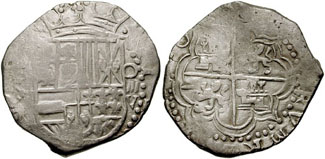

esta plata menuda que aora corre es muy mala, que casi una quarta parte de ella es plomo y de muy baxa ley.This small silver that now circulates is very bad, for nearly a quarter of it is lead and of very low fineness. (translation for the atlas)Juan de Matienzo, Gobierno del Perú (written 1567; ed. Buenos Aires, 1910), cap. 10, p. 168
What served as money share of 6 mentions
List of entries (4)
- 1 Peru, c. 1545–1580s: silver by weight, bars and untaxed plata corriente 1545–1585
- 2 Potosí silver and its mint: cob coins behind the Spanish dollar 1545–1789
- 3 Potosí mint fraud and debasement (1649) 1620–1652
- 4 Bolivia, to 1914: six banks of issue, until the Banco de la Nación got the sole right 1871–1914
Modern 1900 to today
3 entries, 1940–2026
all three companies, regardless of compensating wage increases, claim that they are selling all company store articles, including clothing and luxuries, at a net loss ranging from 28 to 50 per cent.International Labour Office, Labour Problems in Bolivia: Report of the Joint Bolivian-United States Labour Commission (Montreal, 1943), p. 41 (English text)
List of entries (3)
- 1 Bolivian tin mines: food below cost as part of wages 1940–1943
- 2 Hyperinflation: Bolivia (Boliviano) 1984–1985
- 3 Bolivia: bitcoin banned, then allowed 2014–2026
What this cannot show
- How much money of each kind was in use: the marks count entries, not coins, notes or goods.
- A census: the atlas seeks out money made without a state, so an era with few entries is not an era with little money.
- The past's borders: entries are placed by today's, and the same money often ran beyond them; see the map.
Sources quoted on this page
- Rothbard, M. N. 2002. A History of Money and Banking in the United States: The Colonial Era to World War II. Auburn, AL: Ludwig von Mises Institute.
- Juan de Matienzo, Gobierno del Perú (written 1567; ed. Buenos Aires, 1910)
- International Labour Office, Labour Problems in Bolivia: Report of the Joint Bolivian-United States Labour Commission (Montreal, 1943)