Money in Norway
Penger i Norge
Entries placed by today's borders.
Entries 6, in 3 eras
Span 995–1980
Kinds of money Silver penny 2, Rix-dollar 2, State notes 1, Gold coin 1, Silver coin 1, and 1 other
W ithin present-day Norway, the atlas places 6 entries, by their main place or a dated one, from 995 to 1980. The oldest is Norway's first coin (995), struck from Danegeld pennies (995–1000); the most recent, Svalbard: coal-company wage notes (1916–1980). The money named most often is Silver penny, in 2 entries.
The word for money
- Norwegian penger: plural of penning 'penny', the smallest coin. Falk, H. S. & Torp, A., Norwegisch-dänisches etymologisches Wörterbuch (Heidelberg, 1910), vol. 2, s.v. Penge More on the word for money →
Middle period 500–1499
2 entries, 995–1066
are copies of an Anglo-Saxon penny that can be dated to the years 991-997.University of Oslo, Museum of Cultural History, Coin Cabinet, 'Year 995: Norway's first coin' (web exhibition)
Hollow marks: entries elsewhere that share this era's money (Silver penny).
List of entries (2, and 4 elsewhere)
- 1 Norway's first coin (995), struck from Danegeld pennies 995–1000
- 2 Harald Hardrada's coinage: from 90% to 30% silver 1047–1066
Elsewhere
- a Bolesław I, 992–1025: the first Polish pennies, a few among foreign coin Gniezno, 992
- b Hungary, 11th century: fines reckoned in bullocks, each worth a 'pensa' of gold Kingdom of Hungary under Stephen I, 1000
- c Peter's pence: England's yearly payment to Rome England, 921
- d Åland and Finland, 9th-11th centuries: dirhams hoarded as payment on Åland, worn on the mainland Åland Islands, 800
Early modern 1500–1899
3 entries, 1749–1935
caught by the Finns, and which they bring on board the Russians.Leopold von Buch, Travels through Norway and Lapland during the years 1806, 1807, and 1808, tr. J. Black (London 1813), entry Hammerfest, 24 July 1807 (page number not checked)
What served as money share of 5 mentions
Hollow marks: entries elsewhere that share this era's money (Rix-dollar) or that its sources name; the 3 farthest are listed below, not drawn.
List of entries (3, and 8 elsewhere)
- 1 Finnmark: Russian (Pomor) meal bartered for fish, one vog for one vog 1749–1807
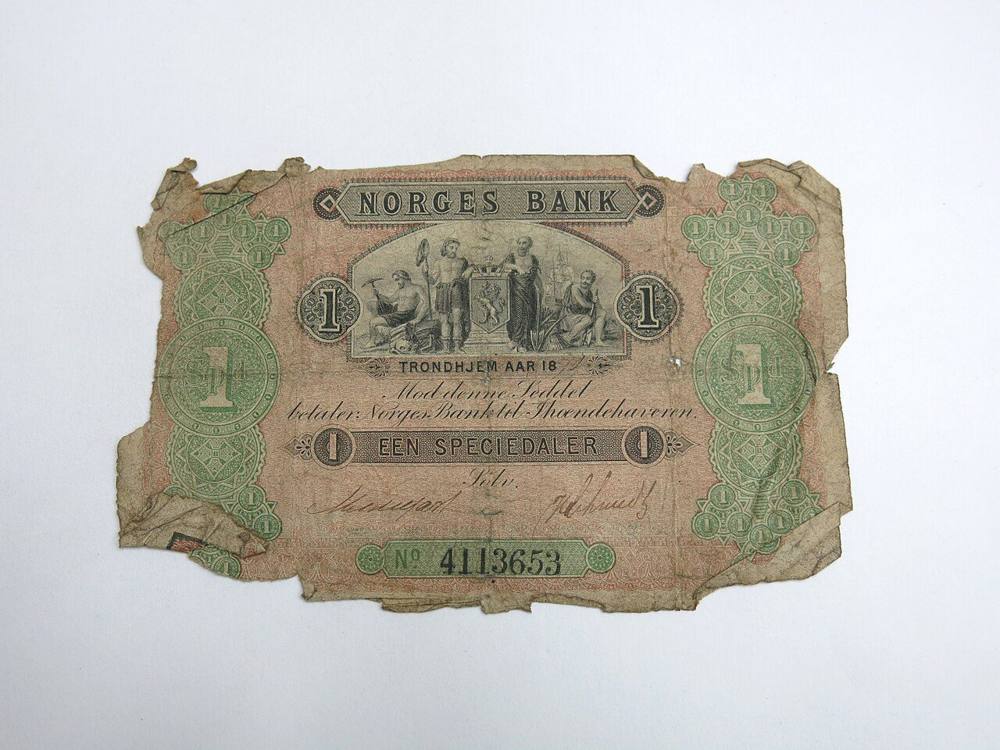
- 2 Norway 1814-42: Riksbank notes collapse; Norges Bank built on a forced silver levy 1814–1842
- 3 The 1870s shift from silver to gold (today in Norway) 1871–1935
Elsewhere
- a Classical gold standard London, 1871
- b The 1870s shift from silver to gold Denmark 1872
- c The 1870s shift from silver to gold Sweden 1872
- d The 1870s shift from silver to gold Netherlands 1875
- e The 1870s shift from silver to gold Paris 1876
- Silver against gold, 1871–1935: what silver money lost in India and China India, 1871
- The 1870s shift from silver to gold India 1893
- Ceylon: VOC credit notes and the imaginary rix-dollar Colombo, 1785
Modern 1900 to today
1 entry, 1916–1980
Kullselskapene trykte egne sedler som de brukte som betalingsmiddel på Svalbard.The coal companies printed their own notes, which they used as a means of payment on Svalbard.Svalbard museum, catalogue record SVB 10849, 'Betalingsmerke utstedt av Store Norske Spitsbergen Kullkompani' (10-krone note, series Qq, 1973), DigitaltMuseum, History
List of entries (1)
- 1 Svalbard: coal-company wage notes 1916–1980
What this cannot show
- How much money of each kind was in use: the marks count entries, not coins, notes or goods.
- A census: the atlas seeks out money made without a state, so an era with few entries is not an era with little money.
- The past's borders: entries are placed by today's, and the same money often ran beyond them; see the map.
Sources quoted on this page
- University of Oslo, Museum of Cultural History, Coin Cabinet, 'Year 995: Norway's first coin' (web exhibition)
- Leopold von Buch, Travels through Norway and Lapland during the years 1806, 1807, and 1808, tr. J. Black (London 1813), entry Hammerfest, 24 July 1807 (page number not checked)
- Svalbard museum, catalogue record SVB 10849, 'Betalingsmerke utstedt av Store Norske Spitsbergen Kullkompani' (10-krone note, series Qq, 1973), DigitaltMuseum