Money in Papua New Guinea
Entries placed by today's borders.
Entries 13, in 2 eras
Span 1875–2010
Kinds of money Shell beads 4, Other shells 3, Animal teeth 3, Tobacco 1, Silver coin 1, and 7 others
W ithin present-day Papua New Guinea, the atlas places 13 entries, by their main place or a dated one, from 1875 to 2010. The oldest is Tolai shell money (tambu) (1875–1891); the most recent, Baruya salt money (1967–1969). The money named most often is Shell beads, in 4 entries.
Early modern 1500–1899
5 entries, 1875–1913

for all commodities, and everything that is capable of being transferred in commerce has a known money value, even the recently introduced European trade.Rickard, R.H., 'The New Britain Currency, or Shell-money', Proceedings of the Royal Society of Victoria 3 (1891), pp. 46-52, esp. p. 50
Hollow marks: entries elsewhere that share this era's money (Greenstone and jade, Other shells, Shell beads); the 3 farthest are listed below, not drawn.
List of entries (5, and 7 elsewhere)
- 1 Tolai shell money (tambu) 1875–1891
- 2 Kaiser-Wilhelmsland and Mioko, 1884–85: stick tobacco as small change and day wage 1884–1885
- 3 Motu shell-disc strings 1885–1910
- 4 German New Guinea, 1887–1913: company marks, foreign coin, and silver kept by chiefs 1887–1913
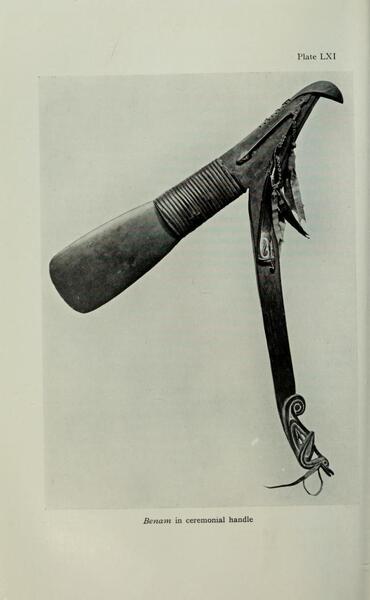
- 5 Massim axe blades as currency 1898–1910
Elsewhere
- a New Georgia clam-shell arm rings (hokata) New Georgia, 1887
- b Naga hills: iron chabili, conch shells and salt Naga Hills, 1880
- c Banks Islands shell money Banks Islands, 1863
- d Langalanga shell-disc money Alite, 1863
- Clamshell disc-bead money (Pomo and southern California) Pomo territory, 1871
- The Pueblos, 1880–85: shell beads and turquoise beside coin Rio Grande, 1880
- Nzimbu shells of Luanda Island Ilha de Luanda, 1578
Modern 1900 to today
8 entries, 1900–2010


The natives sharply distinguish it from barter, which they practise extensively, of which they have a clear idea, and for which they have a settled term — in Kiriwinian : gimwali.B. Malinowski, Argonauts of the Western Pacific (London, 1922), p. 96
What served as money share of 10 mentions
Hollow marks: entries elsewhere that share this era's money (Animal teeth, Other shells, Shell beads); the 3 farthest are listed below, not drawn.
List of entries (8, and 4 elsewhere)
- 1 Kula ring 1900–1950
- 2 Admiralty Islands: shell money and dogs' teeth 1907
- 3 Huon Gulf boar tusks and dogs' teeth 1908–1911
- 4 Mafulu dogs' teeth 1910
- 5 Trobriands: gimwali, barter pure and simple 1915–1918
- 6 Rossel Island shell money 1921–2010
- 7 Highland New Guinea shell valuables 1930–1935
- 8 Baruya salt money 1967–1969
Elsewhere
- a Naga hills: iron chabili, conch shells and salt Naga Hills, 1880
- Clamshell disc-bead money (Pomo and southern California) Pomo territory, 1871
- Fijian tabua (whale teeth) Fiji, 1800
- Nzimbu shells of Luanda Island Ilha de Luanda, 1578
What this cannot show
- How much money of each kind was in use: the marks count entries, not coins, notes or goods.
- A census: the atlas seeks out money made without a state, so an era with few entries is not an era with little money.
- The past's borders: entries are placed by today's, and the same money often ran beyond them; see the map.
Sources quoted on this page
- Rickard, R.H., 'The New Britain Currency, or Shell-money', Proceedings of the Royal Society of Victoria 3 (1891), pp. 46-52, esp. p. 50
- B. Malinowski, Argonauts of the Western Pacific (London, 1922)