Money in Democratic Republic of the Congo
La monnaie en République démocratique du Congo
Entries placed by today's borders.
Entries 15, in 3 eras
Span 1000–1998
Kinds of money Copper bars and pieces 3, Brass rods and wire 3, Other commodity 3, Iron implements 3, Raffia cloth 2, and 8 others
W ithin the present-day Democratic Republic of the Congo, the atlas places 15 entries, by their main place or a dated one, from 1000 to 1998. The oldest is Katanga copper crosses (1000–1908); the most recent, Hyperinflation: Democratic Republic of Congo (Franc) (1998). The money named most often is Copper bars and pieces, in 3 entries.
The word for money
- French argent: silver (the white metal). Trésor de la langue française informatisé (ATILF/CNRTL), Étymologie, s.v. argent, Étymol. 1 (881-82) More on the word for money →
- Lingala mosolo: money; earlier meaning not known dictionaries disagree. Stapleton, W. H., Comparative Handbook of Congo Languages (Yakusu: Hannah Wade Printing Press, Baptist Missionary Society, 1903), p. 238, section 707, Ngala version of Luke 15 More on the word for money →
- Kituba mbongo: cloth, goods, wealth (the Kongo word) dictionaries disagree. Swift, L. B., and Zola, E. W. A., Kituba Basic Course (Washington: Foreign Service Institute, 1963), Unit 1, vocabulary More on the word for money →
- Tshiluba (Luba-Kasai) mpalata: coin, money; from Portuguese prata, silver dictionaries disagree. Morrison, W. M., Grammar and Dictionary of the Buluba-Lulua Language (New York: American Tract Society, 1906), Buluba-English dictionary, s.v. Mpalata More on the word for money →
- Swahili pesa: pesa: the Indian pice (quarter anna); fedha: silver (from Arabic). Krapf, J. L., A Dictionary of the Suahili Language (London, 1882), s.v. Pesa (2) More on the word for money →
Middle period 500–1499
1 entry, 1000–1908

But four or five pieces of copper and some goats were given for those that remained undamaged.V. L. Cameron, Across Africa, vol. 1 (London, 1877), p. 319, p. 319, May 1874
Hollow marks: entries elsewhere that share this era's money (Copper bars and pieces); the 3 farthest are listed below, not drawn.
List of entries (1, and 6 elsewhere)
- 1 Katanga copper crosses 1000–1908
Elsewhere
- a Copper bars of Takedda Takedda, 1353
- b Zambezi: gold by weight, copper and pewter bars, beads and cloth Sena, 1586
- c St Helena: stamped copper bars and the company halfpenny Jamestown, 1683
- Dejima, 1641–1775: the shogunate sets the Dutch terms — a yearly cap, appraised prices, copper not silver Dejima, 1641
- Stockholms Banco notes Stockholm, 1661
- Bassac and Ubon: copper lat ingots as small change, 1866–1883 Bassac, 1866
Early modern 1500–1899
5 entries, 1849–1909
At present in the Upper Congo all payments made to the natives consist of merchandise whose value is fixed by the commercial companies.The Congo: a report of the Commission of Enquiry appointed by the Congo Free State Government (report dated 1905; English translation, New York, 1906), ch. I The Land Regime, p. 24
What served as money share of 12 mentions
Hollow marks: entries elsewhere that share this era's money (Brass rods and wire, Glass beads); the farthest is listed below, not drawn.
List of entries (5, and 5 elsewhere)
- 1 Brass rods on the middle Congo 1849–1908
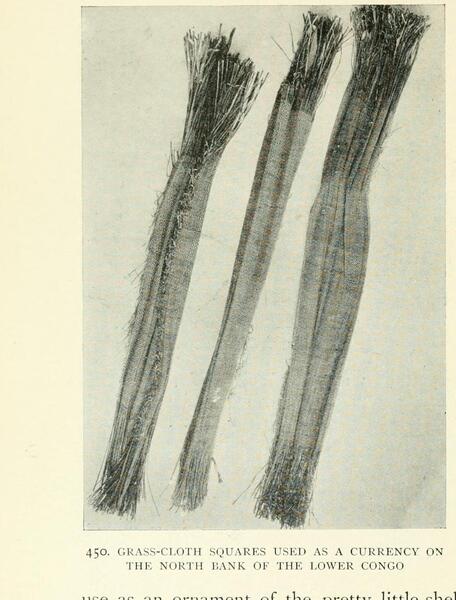
- 2 Raffia cloth currency in Kongo 1879–1885
- 3 Congo Free State coins, 1887–1909: little used, valued by their metal 1887–1909
- 4 Congo Free State, 1891–1908: taxes in rubber and food, paid back in goods 1891–1908
- 5 Lake Mantumba, 1903: gum-copal and fish tax, paid in cloth or rods 1893–1903
Elsewhere
- a IBEA Company caravans, 1890–92: food bought with beads, wire and cloth Caravan road from Mombasa by Machakos to Kampala, 1890
- b Wadai: cloth for money, beads for small change Abeshe, 1851
- c Unyamwezi: beads, cloth and wire as currency Msene, 1857
- d Aggry and trade glass beads Gold Coast, 1480
- Palauan bead money (udoud) Palau, 1871
Modern 1900 to today
9 entries, 1901–1998


In reality he is subjected to a State tax.The Congo: a report of the Commission of Enquiry appointed by the Congo Free State Government (report dated 1905; English translation, New York, 1906), ch. The Concessions, p. 111
Hollow marks: entries elsewhere that share this era's money (Cowrie shells, Iron implements); the farthest is listed below, not drawn.
List of entries (9, and 3 elsewhere)
- 1 Sankuru, c. 1905: a state tax payable only in croisettes, sold for rubber 1901–1905
- 2 Leopoldville: wages paid in store cloth 1903
- 3 Shoka and ngbele: iron blade money at Stanley Falls 1903–1908
- 4 Bankutu and Basongo Meno: throwing-knife, copper-bar (konga, boloko) and blade money 1907–1909
- 5 Kuba (Bushongo): raphia cloth, then cowries, then trade cloth 1907–1909
- 6 Topoke spear-blade money (doa and dihunga) 1907–1909
- 7 Hyperinflation: Congo (Zaire) (Zaïre) 1991–1992
- 8 Hyperinflation: Congo (Zaire) (Zaïre) 1993–1994
- 9 Hyperinflation: Democratic Republic of Congo (Franc) 1998
Elsewhere
- a Buganda: cowrie prices and clan help with debts Buganda, 1886
- b Iron hoes as bridewealth currency Thonga country, 1870
- Naga hills: iron chabili, conch shells and salt Naga Hills, 1880
What this cannot show
- How much money of each kind was in use: the marks count entries, not coins, notes or goods.
- A census: the atlas seeks out money made without a state, so an era with few entries is not an era with little money.
- The past's borders: entries are placed by today's, and the same money often ran beyond them; see the map.
Sources quoted on this page
- V. L. Cameron, Across Africa, vol. 1 (London, 1877), p. 319
- The Congo: a report of the Commission of Enquiry appointed by the Congo Free State Government (report dated 1905; English translation, New York, 1906)