Money in Switzerland
Geld in der Schweiz
Entries placed by today's borders.
Entries 9, in 3 eras
Span 1340–2026
Kinds of money Gold by weight 3, Dues in kind 2, State notes 2, Silver coin 1, Private bank notes 1, and 4 others
W ithin present-day Switzerland, the atlas places 9 entries, by their main place or a dated one, from 1340 to 2026. The oldest is Engelberg valley: Easter eggs owed to the abbey with cheese, Ziger and pence (1340–1360); the most recent, Swiss sovereign-money (Vollgeld) initiative (2018). The money named most often is Gold by weight, in 3 entries.
The word for money
- Swiss German Gäld: debt, payment: from the verb gelten 'to pay, be worth'. Schweizerisches Idiotikon, vol. 2 (1885), col. 240, s.v. Gelt, Geld I More on the word for money →
- French argent: silver (the white metal). Trésor de la langue française informatisé (ATILF/CNRTL), Étymologie, s.v. argent, Étymol. 1 (881-82) More on the word for money →
- Italian soldi: soldo < Latin solidus, a gold (later silver) coin, literally 'whole piece'; denaro < denarius 'of ten'. Pianigiani, O., Vocabolario etimologico della lingua italiana (1907), s.v. soldo, s.v. soldo More on the word for money →
- Romansh daners: the Roman denarius, a silver coin. Schorta, A., Dicziunari Rumantsch Grischun, vol. 5 (1968), s.v. daner, vol. 5, p. 55 More on the word for money →
Middle period 500–1499
1 entry, 1340–1360
ANDRER ENGELBERGER HOFRODEL 1). (wahrscheinlich aus der mitte des 14 jh.)Second Engelberg Hofrodel (probably from the middle of the 14th century). (translation for the atlas)Grimm, J. (ed.), Weisthümer, vol. I (Göttingen, 1840), p. 2, 'Andrer Engelberger Hofrodel', vol. I, p. 2
List of entries (1)
Early modern 1500–1899
3 entries, 1526–1910
decreed the withdrawal of all the old Swiss Coins, and excluded Austrian and German Coins.Same, p. 199
What served as money share of 3 mentions
Hollow marks: entries elsewhere that its sources name.
List of entries (3, and 1 elsewhere)
- 1 Zürich countryside: egg dues ('Kueeier', 1526) and their money equivalent ('Eiergelt', 1845) 1526–1845
- 2 Switzerland: cantonal coins and foreign silver, replaced by the federal franc (1850) 1825–1865
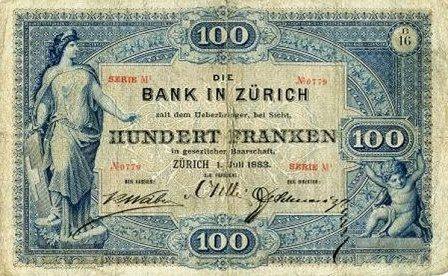
- 3 Switzerland: many banks of issue and a note concordat (1834-1907) 1834–1910
Elsewhere
Modern 1900 to today
5 entries, 1934–2026


Since 1934 the Swiss Wirtschaftsring/Cercle Économique (Economic Circle), now the WIR-Bank, has issued its own currency, not backed by Swiss Francs.Stodder, James and Bernard Lietaer. 2016. 'The Macro-Stability of Swiss WIR-Bank Credits: Balance, Velocity, and Leverage'. Comparative Economic Studies 58(4) (author-hosted annotated version).
What served as money share of 9 mentions
List of entries (5)
- 1 WIR (Wirtschaftsring) credit currency 1934–2016
- 2 Switzerland: private gains on gold and bitcoin untaxed 1995–2026
- 3 Swiss franc cut from gold in law, 1999-2000: new constitution, then the currency act 1999–2000
- 4 Swiss gold initiative, 2014: voters refuse a 20 per cent gold floor for the National Bank 2014
- 5 Swiss sovereign-money (Vollgeld) initiative 2018
What this cannot show
- How much money of each kind was in use: the marks count entries, not coins, notes or goods.
- A census: the atlas seeks out money made without a state, so an era with few entries is not an era with little money.
- The past's borders: entries are placed by today's, and the same money often ran beyond them; see the map.
Sources quoted on this page
- Grimm, J. (ed.), Weisthümer, vol. I (Göttingen, 1840), p. 2, 'Andrer Engelberger Hofrodel'
- Same
- Stodder, James and Bernard Lietaer. 2016. 'The Macro-Stability of Swiss WIR-Bank Credits: Balance, Velocity, and Leverage'. Comparative Economic Studies 58(4) (author-hosted annotated version).