Money in Canada
Entries placed by today's borders.
Entries 32, in 2 eras
Span 1534–1984
Kinds of money Barter, no money 7, Money of account 4, Emergency scrip 3, Private bank notes 3, Beaver skins 2, and 24 others
W ithin present-day Canada, the atlas places 32 entries, by their main place or a dated one, from 1534 to 1984. The oldest is Chaleur Bay, 1534: skins for iron (1534); the most recent, LETS 'green dollars' (Comox Valley) (1983–1984). The money named most often is Barter, no money, in 7 entries.
The word for money
- English money: Latin moneta 'mint', a surname of Juno in whose temple at Rome coin was struck dictionaries disagree. Skeat, W. W., An Etymological Dictionary of the English Language, new ed. (Oxford, 1898), s.v. MONEY More on the word for money →
- French argent: silver (the white metal). Trésor de la langue française informatisé (ATILF/CNRTL), Étymologie, s.v. argent, Étymol. 1 (881-82) More on the word for money →
Early modern 1500–1899
25 entries, 1534–1949


and use it as we do gold and silver, and hold it the most precious thing in the world.Jacques Cartier, second voyage (1535-36), transl. J. P. Baxter, A Memoir of Jacques Cartier (New York, 1906), p. 165
Listed below, not drawn (too far away for this map): entries elsewhere that share this era's money (Beaver skins, Canadian dollar, Deer and moose skins, Hides and robes, Wampum) or that its sources name.
List of entries (25, and 8 elsewhere)
- 1 Chaleur Bay, 1534: skins for iron 1534
- 2 Hochelaga, 1535: shell beads used as gold and silver 1535
- 3 Huron reparation for a murder, 1648 1648
- 4 Quebec, 1674: moose skins made legal tender 1674
- 5 Made Beaver: Hudson's Bay unit of account 1678–1908
- 6 Newfoundland outports: fish against supplies on the merchant's account 1680–1895
- 7 Montreal: beaver trade and the canoe licences 1684–1686
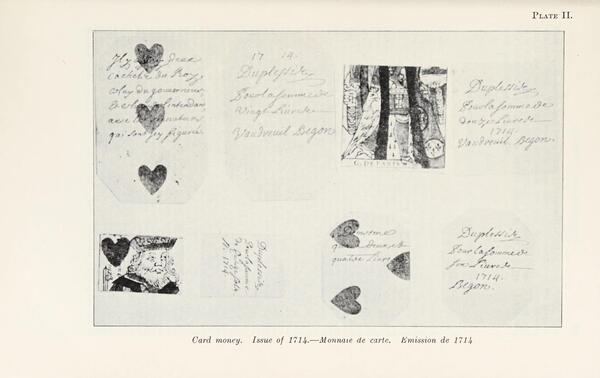
- 8 Card money of New France 1685–1719
- 9 Horses as standard of value on the Plains 1750–1880
- 10 Coppermine river: copper for iron 1771
- 11 Nootka Sound, 1778: nothing but metal 1778
- 12 Athabasca: the fur-trade credit cycle 1787–1793
- 13 Lower Canada, 1808–1837: foreign coins rated in Halifax currency 1808–1837
- 14 Buffalo robes as money 1830–1880
- 15 Lower Canada, 1837–38: merchants' bons after the banks suspended 1837–1838
- 16 Upper Yukon: a gun for its height in furs 1848–1852
- 17 Hudson's Bay Company notes 1849–1894
- 18 Kwakwaka'wakw blankets and coppers 1849–1897
- 19 Canadian chartered-bank notes 1850–1944
- 20 Newfoundland dollar, 1863-1949: the colony's own dollars and cents, and its $2 gold coin 1863–1949
- 21 Treaties 6 and 7, 1876-77: five dollars a head a year, in cash 1876–1877
- 22 Baffin Island: bearskins for the whalers 1883–1884
- 23 Labrador: the truck system 1892–1918
- 24 Newfoundland, 1894: the Union and Commercial bank notes fail on 'Black Monday' 1894–1895
- 25 Klondike gold dust 1897–1898
Elsewhere
- Albany, 1684: beaver skins as tokens and satisfaction Albany, 1684
- Buffalo robes as money Mandan 1833
- Buffalo robes as money Fort Union 1851
- Made Beaver: Hudson's Bay unit of account Fort Yukon 1867
- Natchitoches: trade goods on credit, repaid in skins at fixed rates Natchitoches, 1770
- Green River rendezvous: beaver against dollar prices Green River rendezvous, 1836
- Alta California: hides as 'California bank notes' Monterey, 1835
- Comanche mule trade on the Canadian River Canadian River valley, 1839
Modern 1900 to today
7 entries, 1910–1984


They bartered each pelt or bundle of deerskins for so much money, the price was handed to them and they then bought with the amount as far as it went.Hesketh-Prichard, H., Through Trackless Labrador (1911), ch. XV
What served as money share of 8 mentions
List of entries (7)
- 1 Labrador: pelts priced in money 1910
- 2 Copper Inuit: food shared by rule, other things lent, given back or bartered 1914–1916
- 3 Blaine wooden nickels 1933
- 4 Alberta prosperity certificates, 1936-1939: dated stamp scrip of the Social Credit government 1936–1939
- 5 Alberta Credit, 1937: a provincial credit unit, and the bank acts Ottawa disallowed 1937–1938
- 6 Hutterite colonies: no private property, no wages; Alberta limits colony land, 1942-1973 1942–1973
- 7 LETS 'green dollars' (Comox Valley) 1983–1984
What this cannot show
- How much money of each kind was in use: the marks count entries, not coins, notes or goods.
- A census: the atlas seeks out money made without a state, so an era with few entries is not an era with little money.
- The past's borders: entries are placed by today's, and the same money often ran beyond them; see the map.
Sources quoted on this page
- Jacques Cartier, second voyage (1535-36), transl. J. P. Baxter, A Memoir of Jacques Cartier (New York, 1906), p. 165
- Hesketh-Prichard, H., Through Trackless Labrador (1911), ch. XV