Money in Bulgaria
Парите в България
Entries placed by today's borders.
Entries 19, in 4 eras
Span 5000 BC – 2026
Kinds of money Gold by weight 3, Spondylus shell 2, Silver coin 2, Grosso 2, Hyperpyron 2, and 12 others
W ithin present-day Bulgaria, the atlas places 19 entries, by their main place or a dated one, from 5000 BC to 2026. The oldest is Spondylus shell rings in the Balkan Copper Age (5000 BC–4300 BC); the most recent, Bulgaria's currency board: the lev tied to the Deutsche Mark (1997–2025). The money named most often is Gold by weight, in 3 entries.
The word for money
- Bulgarian пари pari: 'piece, share' (Persian pārä), via the Ottoman coin para. Български етимологичен речник, т. V (София: БАН, 1996), s.v. пара, p. 59 More on the word for money →
Prehistory before 3000 BC
3 entries, 5000 BC–4200 BC
has revealed at least two minimal weight units of 0.145 and 0.415 g.Kostov, 'Prehistorical weight system among the golden objects from the Varna Chalcolithic necropolis', Geology and Mineral Resources 11(3) (2004), 25–28
What served as money share of 3 mentions
List of entries (3)
- 1 Spondylus shell rings in the Balkan Copper Age 5000 BC–4300 BC
- 2 Solnitsata salt production 4700 BC–4200 BC
- 3 Varna gold and spondylus 4600 BC–4400 BC
Antiquity 3000 BC – AD 499
5 entries, 2500 BC–72 BC


the analyses of the objects from Dabene show the broad usage of sintering on alluvial gold in the production of the majority of the objects (Tsintsov et al. 2009; Tsaneva et al. 2011a; 2011b; Hristov 2011, 146–147)Hristov, 'Gold Items from southern Bulgaria and western Anatolia in the Early Bronze Age', BeJA 16.1 (2026), 21-43, pp. 26-28, 36
Hollow marks: entries elsewhere that share this era's money (Greek coin, Oxhide ingots) or that its sources name.
List of entries (5, and 8 elsewhere)
- 1 Dabene weight-standardised miniature gold 2500 BC–2000 BC
- 2 Oxhide copper ingots in Thrace 1450 BC–1200 BC
- 3 Atia hoard of bronze arrow-coins near Apollonia 400 BC–201 BC
- 4 Lysimachos and the posthumous west-Pontic staters (today in Bulgaria) 306 BC–72 BC
- 5 Celtic silver coins and an ingot at Zgorigrad 242 BC–218 BC
Elsewhere
- a Paeonian royal silver Paeonia, 400 BC
- b Athenian horoi: land pledged for debt Athens, 400 BC
- c Lysimachos and the posthumous west-Pontic staters Istros c.215 BC
- d Carthage begins to coin Punic Sicily, 410 BC
- e Samothrace, after 281 BC: a late coinage Samothrace, 281 BC
- f Qataban and Saba, 4th century BC – 2nd century AD: South Arabian coin Qataban, 350 BC
- g Thasian or Thracian? The silenus-and-nymph silver Thasian Peraia, 530 BC
- h Oxhide copper ingots (Uluburun ship) Uluburun wreck, 1600 BC
Middle period 500–1499
7 entries, 610–1393
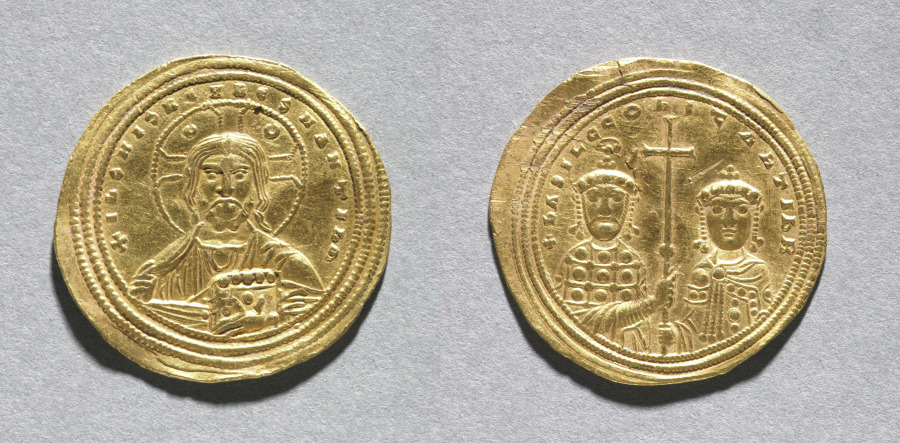
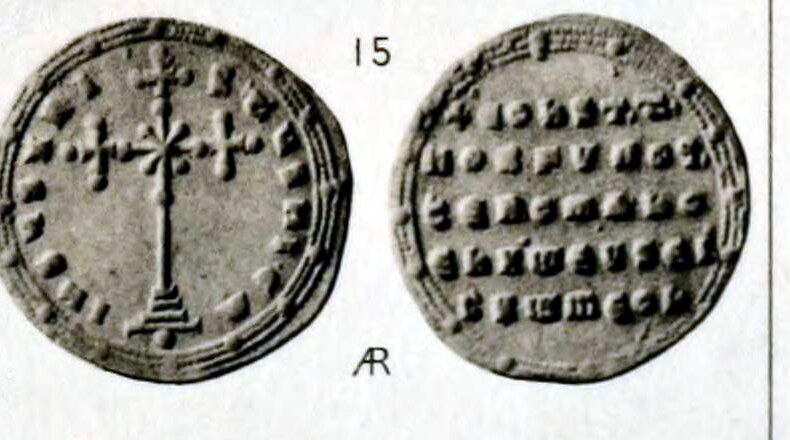
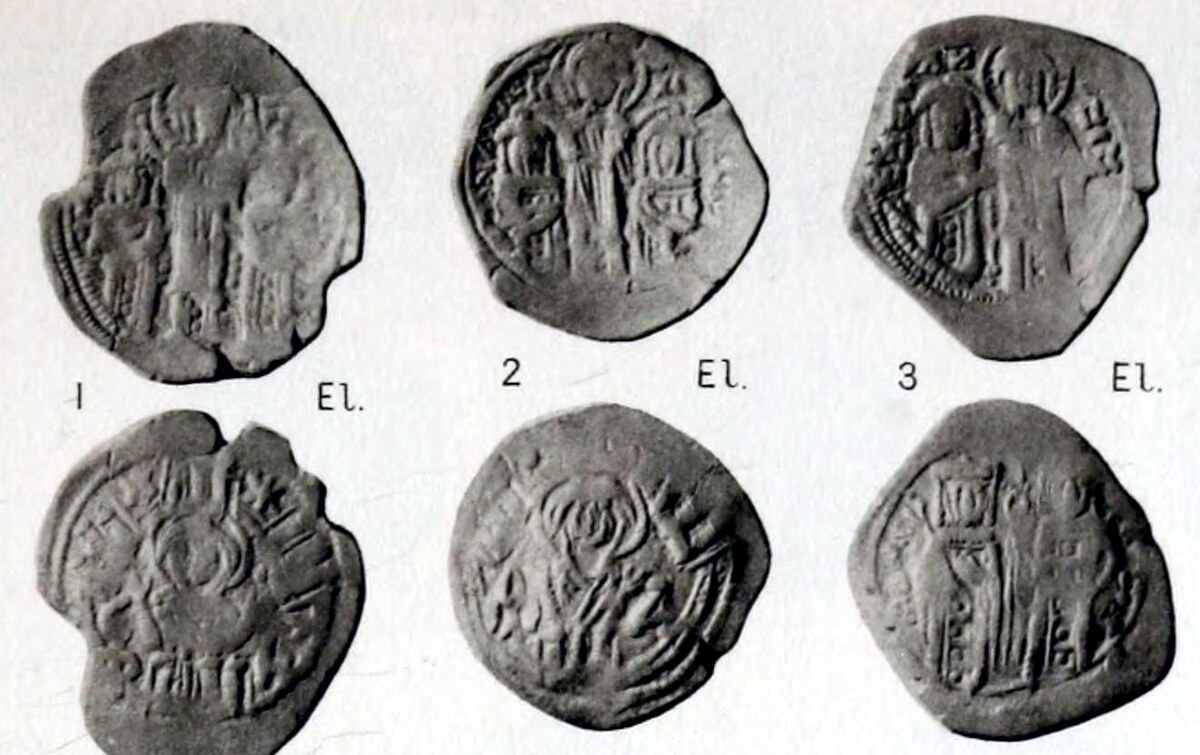
comprises fifteen silver Byzantine coins (miliarensia) from the 10th c.V. Penchev, 'What the coins from the Preslav treasure can tell us about the social status of its owner', Contributions to Bulgarian Archaeology 12 (2022) 69-74, doi:10.53250/cba12.69-74, p. 69
Hollow marks: entries elsewhere that share this era's money (Grosso, Hyperpyron, Solidus) or that its sources name.
List of entries (7, and 7 elsewhere)
- 1 Coin gap on the Upper Thracian plain 610–800
- 2 Byzantine payments to the Bulgars, 681–966 (today in Bulgaria) 681–966
- 3 Gold in the Bulgar rulers' treasuries, 809–1018 809–1018
- 4 Preslav treasure: Byzantine silver kept unspent 945–971
- 5 Coins of the Second Bulgarian tsars 1195–1393
- 6 Byzantine gold hyperpyra in 14th-century Bulgaria (today in Bulgaria) 1300–1350
- 7 Ivan Alexander's charter to Venice, 1352: dues in perperi 1352
Elsewhere
- a Gold in the Bulgar rulers' treasuries, 809–1018 Ochrid 1018
- b Serbia, c. 1300-1354: the king's silver dinar, Dante's charge of copying Venice, and Dušan's law on coining Serbian kingdom, 1300
- c The Venetian silver grosso Venice, 1192
- d Dubrovnik, 1337-1394: the commune's coin, where even a good copy was a crime Dubrovnik, 1337
- e Nicephorus II’s light nomisma (tetarteron), 963–969 Constantinople, 963
- f Moldavia, 1370s–1690s: debased groshes, Dabija's copper shillings and copies of foreign coin Suceava, 1373
- g Visigothic law: no refusing a full-weight solidus Toledo, 642
Modern 1900 to today
4 entries, 1966–2026
In Article 33(3), the words "virtual currencies" are replaced by "crypto-assets".Markets in Crypto-Assets Act (SG No. 54/4.07.2025), English text published by the Financial Supervision Commission, Transitional and Final Provisions § 20, § 20, item 1
What served as money share of 4 mentions
Hollow marks: entries elsewhere that its entries link to.
List of entries (4, and 1 elsewhere)
- 1 Bulgaria: gold under a state monopoly, then free; bitcoin taxed as income 1966–2026
- 2 Hyperinflation: Bulgaria (Lev) 1991
- 3 Hyperinflation: Bulgaria (Lev) 1997
- 4 Bulgaria's currency board: the lev tied to the Deutsche Mark 1997–2025
Elsewhere
- a Deutsche Mark, then euro, in Kosovo Kosovo, 1999
What this cannot show
- How much money of each kind was in use: the marks count entries, not coins, notes or goods.
- A census: the atlas seeks out money made without a state, so an era with few entries is not an era with little money.
- The past's borders: entries are placed by today's, and the same money often ran beyond them; see the map.
Sources quoted on this page
- Kostov, 'Prehistorical weight system among the golden objects from the Varna Chalcolithic necropolis', Geology and Mineral Resources 11(3) (2004), 25–28
- Hristov, 'Gold Items from southern Bulgaria and western Anatolia in the Early Bronze Age', BeJA 16.1 (2026), 21-43, pp. 26-28, 36
- V. Penchev, 'What the coins from the Preslav treasure can tell us about the social status of its owner', Contributions to Bulgarian Archaeology 12 (2022) 69-74, doi:10.53250/cba12.69-74
- Markets in Crypto-Assets Act (SG No. 54/4.07.2025), English text published by the Financial Supervision Commission, Transitional and Final Provisions § 20