Money in Italy
Il denaro in Italia
Entries placed by today's borders.
Entries 32, in 4 eras
Span 451 BC – 1977
Kinds of money Gold coin 4, Silver coin 4, Copper or bronze by weight 3, Roman denarius 3, Florin 3, and 16 others
W ithin present-day Italy, the atlas places 32 entries, by their main place or a dated one, from 451 BC to 1977. The oldest is Early Rome: bronze weighed on the scales (451 BC–289 BC); the most recent, Italy, 1976–1977: banks' small cheques ('miniassegni') used as change (1976–1977). The money named most often is Gold coin, in 4 entries.
The word for money
- Italian soldi: soldo < Latin solidus, a gold (later silver) coin, literally 'whole piece'; denaro < denarius 'of ten'. Pianigiani, O., Vocabolario etimologico della lingua italiana (1907), s.v. soldo, s.v. soldo More on the word for money →
Antiquity 3000 BC – AD 499
10 entries, 451 BC – 553


propter os uero fractum aut conlisum trecentorum assium poena erat, si libero os fractum erat; at si seruo, CL; propter ceteras uero iniurias XXV assium poena erat constituta.for a broken or crushed bone the penalty was 300 asses if a free man's bone was broken, 150 if a slave's; for other injuries a penalty of 25 asses was setGaius, Institutes (2nd c. AD), Latin text, The Latin Library, 3.223, Gaius 3.223, citing the Twelve Tables
Hollow marks: entries elsewhere that share this era's money (Greek coin, Roman denarius); the farthest is listed below, not drawn.
List of entries (10, and 8 elsewhere)
- 1 Early Rome: bronze weighed on the scales 451 BC–289 BC
- 2 Carthage begins to coin 410 BC–146 BC
- 3 Rome, c. 350–200 BC: stamped bronze bars and the cast as 350 BC–200 BC
- 4 Rome: the three moneyers, a magistracy of the Republic 300 BC–27 BC
- 5 Salt: Rome's allowance and 'salary' 100 BC – AD 300
- 6 Rome's gold aureus, 46 BC–AD 305: from 1/40 of a pound to about 5 grams 46 BC – AD 305
- 7 Debasement of the Roman denarius AD 64–AD 274
- 8 Rome, c. 271–274: the mint workers’ war under Aurelian AD 271–AD 274
- 9 Solidi taken by weight: 72 to the pound, 366–367 AD 366–AD 367
- 10 Ostrogothic coinage under Theoderic AD 493–553
Elsewhere
- a Qataban and Saba, 4th century BC – 2nd century AD: South Arabian coin Qataban, 350 BC
- b Koson gold staters, mid-1st century BC Orăștie Mountains, 50 BC
- c Ptolemaic grain banks Egypt, 305 BC
- d Lysimachos and the posthumous west-Pontic staters Lysimacheia, 306 BC
- e Paeonian royal silver Paeonia, 400 BC
- f Athenian horoi: land pledged for debt Athens, 400 BC
- g Royal coinage of Tigranes the Great Artaxata, 89 BC
- Hacksilver beyond Rome's northern frontier Ireland, AD 350
Middle period 500–1499
10 entries, 774–1805

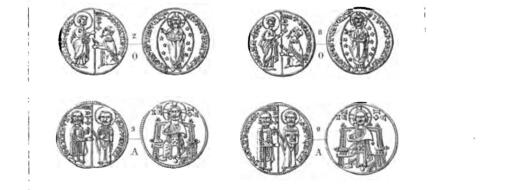

the fiorino d’oro at 25s, while the real coin (fiorino in oro) continued to rise in price.Roberds, W. and F. R. Velde, 'Early Public Banks', Federal Reserve Bank of Atlanta Working Paper 2014-9, p. 8
Hollow marks: entries elsewhere that share this era's money (Florin, Grosso, Silver penny).
List of entries (10, and 8 elsewhere)
- 1 The first papal coins: Hadrian I and Leo III 774–814
- 2 Genoa's coinage and the gold genovino 1139–1413
- 3 The Venetian silver grosso 1192–1202
- 4 The gold florin of Florence 1252–1500
- 5 The Venetian gold ducat of 1284 1284–1797
- 6 Florentine bills of exchange: Pegolotti's usance table 1330–1345
- 7 Monte Comune, Florence: tradable shares in the city's debt 1343–1460
- 8 Failure of the Bardi and Peruzzi, 1345–46 1345–1346
- 9 The Medici Bank, 1397–1494 1397–1494
- 10 Casa di San Giorgio, Genoa: shares in the public debt 1407–1805
Elsewhere
- a Renovatio monetae: periodic re-coinage Scandinavia, 1140
- b Coins of the Second Bulgarian tsars Tarnovo, 1195
- c Barcelona, 1257: a 'perpetual' coin of tern under citizen custodians, with no monetaticum Barcelona, 1257
- d Hungary, 1325–1338: a gold forint on the Florentine standard, while trade kept to Bohemian groats Kingdom of Hungary, 1325
- e Dubrovnik, 1337-1394: the commune's coin, where even a good copy was a crime Dubrovnik, 1337
- f Ivan Alexander's charter to Venice, 1352: dues in perperi Varna, 1352
- g Greater Poland, from 1181: bracteates in Hebrew letters struck by the duke's creditors Gniezno, 1181
- h England, 1206–1408: the King's Exchange — only the king's exchangers may change coin or buy bullion London, 1206
Early modern 1500–1899
11 entries, 1515–1893
It certainly should not be considered as usurious;Fifth Lateran Council, session 10 (4 May 1515), bull on the Montes pietatis, English translation (N. Tanner ed.), session 10, bull on the Montes pietatis
What served as money share of 16 mentions
List of entries (11)
- 1 Fifth Lateran Council on the Montes pietatis, 1515 1515
- 2 Genoese exchange fairs and the scudo di marche 1552–1620
- 3 Banco della Piazza di Rialto, Venice 1574–1638
- 4 Banco del Giro, Venice: state debt as bank money 1619–1806
- 5 Vix pervenit: Benedict XIV on usury, 1745 1745
- 6 Osoppo, 1848: handwritten fortress notes backed by the commune 1848
- 7 Venice, 1848–1849: "moneta patriottica" and city paper under siege 1848–1849
- 8 Italy, 1860–1893: six banks of issue, forced circulation from 1866, Banca Romana's forged notes 1860–1893
- 9 The papal lira, 1866–1870 1866–1870
- 10 Italy, 1866–1883: forced currency by decree, ended with a state gold loan 1866–1883
- 11 Rome under the Italian lira, 1870 1870
Modern 1900 to today
1 entry, 1976–1977
la disponibilità di valute metalliche ha continuato a dimostrarsi ampiamente insufficiente rispetto alle esigenze del pubblico, dando spazio al crescente ricorso a mezzi di pagamento sostitutivi, quali gli assegni circolari di piccolo importo.the supply of metal coin continued to prove widely insufficient for the needs of the public, leaving room for growing recourse to substitute means of payment, such as small-value bankers' cheques. (translation for the atlas)Banca d'Italia, Relazione annuale sul 1976 (1977), note and coin circulation, pp. 8*-9*
List of entries (1)
What this cannot show
- How much money of each kind was in use: the marks count entries, not coins, notes or goods.
- A census: the atlas seeks out money made without a state, so an era with few entries is not an era with little money.
- The past's borders: entries are placed by today's, and the same money often ran beyond them; see the map.
Sources quoted on this page
- Gaius, Institutes (2nd c. AD), Latin text, The Latin Library, 3.223
- Roberds, W. and F. R. Velde, 'Early Public Banks', Federal Reserve Bank of Atlanta Working Paper 2014-9
- Fifth Lateran Council, session 10 (4 May 1515), bull on the Montes pietatis, English translation (N. Tanner ed.)
- Banca d'Italia, Relazione annuale sul 1976 (1977), note and coin circulation