Money in Mexico
El dinero en México
Entries placed by today's borders.
Entries 19, in 3 eras
Span 620–1965
Kinds of money Cacao 4, Barter, no money 3, Cotton mantles 2, Greenstone and jade 2, Spanish dollar 2, and 9 others
W ithin present-day Mexico, the atlas places 19 entries, by their main place or a dated one, from 620 to 1965. The oldest is Calakmul murals: goods shown, money left open (620–700); the most recent, Cuauhtémoc Mennonites: the orphans' fund (Waisenamt) as colony bank, 1922-1965 (1922–1965). The money named most often is Cacao, in 4 entries.
The word for money
- Spanish dinero: Latin denarius, the Roman silver coin 'containing ten' (asses). Pianigiani, O., Vocabolario etimologico della lingua italiana (1907), s.v. denaro, s.v. denaro More on the word for money →
- Nahuatl (Classical) † tomin: tomin: the Spanish tomín (a real, a silver coin); cacahuatl: cacao bean; tlacohualoni: 'that with which things are bought'. Molina, A. de, Vocabulario en lengua castellana y mexicana (Mexico, 1571), Castilian-Nahuatl part, s.v. Real More on the word for money →
Middle period 500–1499
7 entries, 620–1857


of thefe 200 are of the value, among the Indians generally, of one rial. They ferve for fmall money or change, both among the Indians and the Spaniards.Diego García de Palacio, letter to Philip II, Guatemala, 8 March 1576; Spanish text and English translation in E. G. Squier (ed.), Collection of Rare and Original Documents, No. 1 (New York, 1860), Squier ed. p. 37 (Squier's English)
Hollow marks: entries elsewhere that share this era's money (Cacao, Greenstone and jade) or that its sources name; the farthest is listed below, not drawn.
List of entries (7, and 8 elsewhere)
- 1 Calakmul murals: goods shown, money left open 620–700
- 2 Copper axe-monies of West Mexico 1200–1550
- 3 Cacao beans 1300–1637
- 4 Cotton mantles (quachtli) 1400–1560
- 5 Mexica loans, pledges and interest 1428–1565
- 6 Greenstone (chalchihuitl) in central Mexico: treasure and payment 1430–1521
- 7 Spanish dollar (piece of eight) as world money (today in Mexico) 1497–1857
Elsewhere
- a Guanaja, 1502: the trading canoe and the cacao beans used as money Guanaja, 1502
- b El Salvador, 1524–1599: cacao beans as small change beside the real La Trinidad, 1524
- c Nicaragua, 1520s: cacao as money in the tiangüez Nicaragua, 1527
- d Kingdom of Guatemala: cacao as current money, 1546–c. 1690 Santiago de los Caballeros de Guatemala, 1546
- e Guiana: green stones as Carib money Oyapock, 1596
- f Curaçao, 1648–1756: Spanish gold, silver and cacao traded against enslaved Africans Willemstad, 1648
- g Costa Rica: cacao as money, 1687–1738 Costa Rica, 1687
- Spanish dollar (piece of eight) as world money Potosí 1574
Early modern 1500–1899
11 entries, 1500–1917

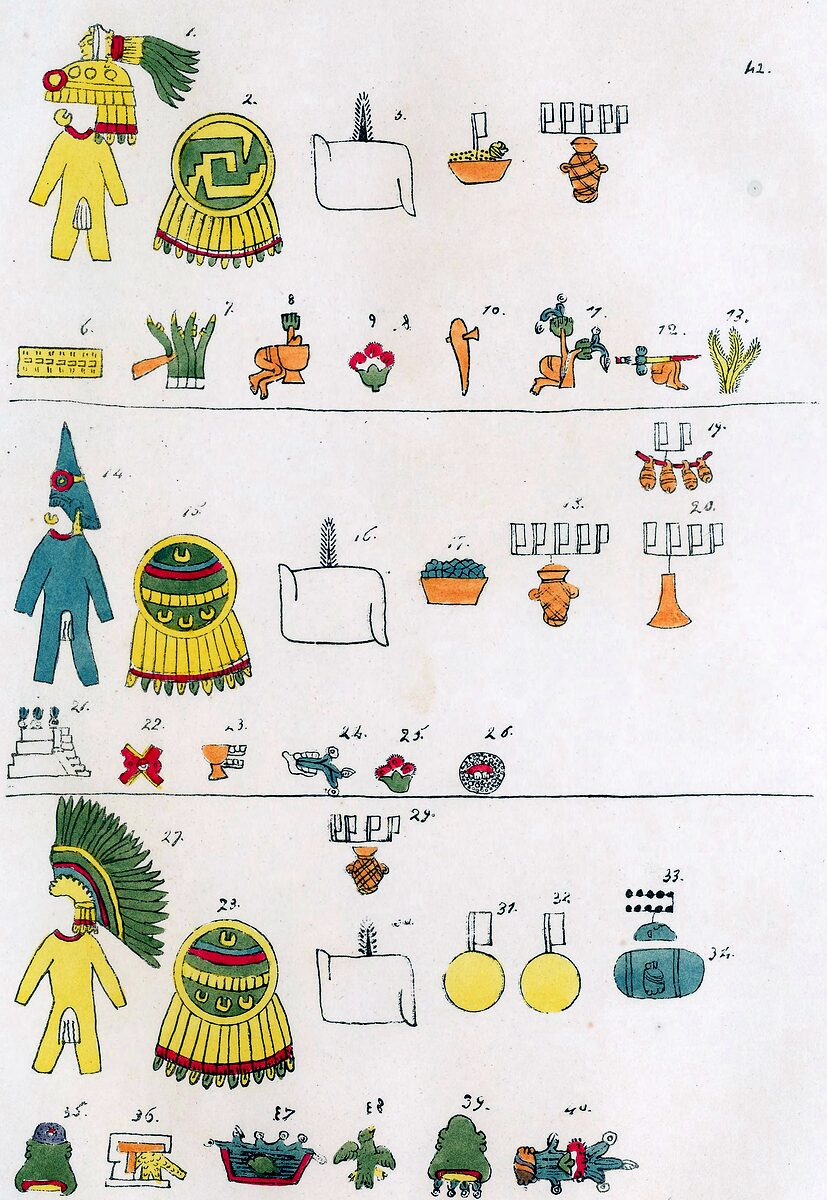


en los mercados tratavan de todas quantas cosas avía en essa tierra.Landa, ed. Brasseur (1864), § XXIII, p. 130
Hollow marks: entries elsewhere that share this era's money (Cacao, Greenstone and jade, Shell beads) or that its sources name; the 3 farthest are listed below, not drawn.
List of entries (11, and 8 elsewhere)
- 1 Maya stone and shell beads as money 1500–1566
- 2 Gold dust in quills (Tlatelolco) 1519
- 3 Moctezuma's tribute and its account books 1519–1520
- 4 Magdalena Bay, 1539: pearl shells and feathers left for beads on a rock 1539
- 5 Cedros Island, 1540: fish for beads, seal-skins taken and ordered restored 1540
- 6 Acapulco and Manila, 1593–1767: silver shipped beyond the cap 1593–1767
- 7 The Manila galleon, 1593–1815: the crown's cap on silver (permiso) 1593–1815
- 8 East Texas, 1751–1775: governors trading French goods against the law (today in Mexico) 1751–1775
- 9 Northern Mexico: raw bar silver (plata pasta) below the mint price 1810–1827
- 10 Mexico, before 1867: soap in the towns and eggs in the country as small change 1867
- 11 Mexico, 1897–1916: banks of issue under the credit law, until Carranza seized them 1897–1917
Elsewhere
- a East Texas, 1751–1775: governors trading French goods against the law Natchitoches 1751
- b Guanaja, 1502: the trading canoe and the cacao beans used as money Guanaja, 1502
- c Guiana: green stones as Carib money Oyapock, 1596
- d El Salvador, 1524–1599: cacao beans as small change beside the real La Trinidad, 1524
- e Kingdom of Guatemala: cacao as current money, 1546–c. 1690 Santiago de los Caballeros de Guatemala, 1546
- The Manila galleon, 1593–1815: the crown's cap on silver (permiso) Manila 1606
- Seville's treasure registers, 1503–1660: gold and silver from the Indies by the books Seville, 1503
- Hochelaga, 1535: shell beads used as gold and silver Hochelaga, 1535
Modern 1900 to today
1 entry, 1922–1965
este gobierno 110 presentará ohjeGión alguna a <JUC los miembros de su secta establezcan entre ellos mismos el régimen económico que voluntariamente se propongan adoptarÓscar Tábares Soltero, Condición legal de los menonitas (tesis de licenciatura, Facultad de Derecho, UNAM, México 1965), transcribing the concession of President Álvaro Obregón, 25 February 1921, pp. 46-47, clause 5 (gloss: "this government will raise no objection to the members of your sect establishing among themselves the economic regime they voluntarily choose")
List of entries (1)
What this cannot show
- How much money of each kind was in use: the marks count entries, not coins, notes or goods.
- A census: the atlas seeks out money made without a state, so an era with few entries is not an era with little money.
- The past's borders: entries are placed by today's, and the same money often ran beyond them; see the map.
Sources quoted on this page
- Diego García de Palacio, letter to Philip II, Guatemala, 8 March 1576; Spanish text and English translation in E. G. Squier (ed.), Collection of Rare and Original Documents, No. 1 (New York, 1860)
- Landa, ed. Brasseur (1864)
- Óscar Tábares Soltero, Condición legal de los menonitas (tesis de licenciatura, Facultad de Derecho, UNAM, México 1965), transcribing the concession of President Álvaro Obregón, 25 February 1921