Money in United Kingdom
Entries placed by today's borders.
Entries 40, in 4 eras
Span 54 BC – 2026
Kinds of money Private bank notes 6, Gold coin 5, Silver penny 4, Pound sterling 4, Coin (other) 3, and 21 others
W ithin the present-day United Kingdom, the atlas places 40 entries, by their main place or a dated one, from 54 BC to 2026. The oldest is Iron currency bars in Britain (54 BC – AD 43); the most recent, United Kingdom: spending bitcoin is a taxable disposal (2021–2026). The money named most often is Private bank notes, in 6 entries.
The word for money
- English money: Latin moneta 'mint', a surname of Juno in whose temple at Rome coin was struck dictionaries disagree. Skeat, W. W., An Etymological Dictionary of the English Language, new ed. (Oxford, 1898), s.v. MONEY More on the word for money →
- Welsh arian: silver, from a root meaning 'white, shining'. Geiriadur Prifysgol Cymru (University of Wales Dictionary), s.v. arian, s.v. arian, etymology More on the word for money →
Antiquity 3000 BC – AD 499
2 entries, 54 BC – 500


Britain no longer was in the Roman monetary sphere.Mathisen, Barbarians, Hoards, and Hacksilver in Late Antiquity: The New Silver Monetary Zone on Rome's Northern Frontier, Chadwick Memorial Lecture 32 (Cambridge, 2024)
List of entries (2)
- 1 Iron currency bars in Britain 54 BC – AD 43
- 2 Hacksilver beyond Rome's northern frontier AD 350–500
Middle period 500–1499
13 entries, 921–2026


it was resolved that tribute should be given, for the first time, to the Danes, for the great terror they occasioned by the sea-coast. That was first 10,000 pounds.The Anglo-Saxon Chronicle, trans. J. Ingram (1823) eBook #657
Hollow marks: entries elsewhere that share this era's money (Silver penny, Wadmal).
List of entries (13, and 8 elsewhere)
- 1 Peter's pence: England's yearly payment to Rome 921–1327
- 2 Danegeld: English tribute in silver to Viking armies 991–1018
- 3 Normandy: monetagium, a hearth tax paid so the duke would not change the coin (today in the United Kingdom) 1100–1300
- 4 Private tallies in medieval England 1170–1400
- 5 Exchequer tally sticks 1179–1826
- 6 England, 1206–1408: the King's Exchange — only the king's exchangers may change coin or buy bullion 1206–1408
- 7 Papal taxes in England taken by weight 1229–1292
- 8 Italian bankers to the papal camera 1233–1327
- 9 The Trial of the Pyx 1248–2026
- 10 English villages, 1290s–1480: debts between neighbours sued in the manor court 1277–1480
- 11 Edward I bans pollards and crockards 1299
- 12 Papal annates, first levied in 1306 1306–1309
- 13 Shetland: scat and rents in wadmal, butter and oil 1469–1809
Elsewhere
- a Iceland: cloth and cow-values as money Iceland, 1100
- b Bolesław I, 992–1025: the first Polish pennies, a few among foreign coin Gniezno, 992
- c Norway's first coin (995), struck from Danegeld pennies Norway, 995
- d Aragon and Valencia: the monedaje, paid every seven years for an unchanged coin (1223-1266) Kingdom of Aragon, 1223
- e Hungary, 11th century: fines reckoned in bullocks, each worth a 'pensa' of gold Kingdom of Hungary under Stephen I, 1000
- f Barcelona, 1257: a 'perpetual' coin of tern under citizen custodians, with no monetaticum Barcelona, 1257
- g Renovatio monetae: periodic re-coinage Scandinavia, 1140
- h Genoa's coinage and the gold genovino Genoa, 1139
Early modern 1500–1899
21 entries, 1544–2026


value of sixpence, and not otherwise, nor in any other manner.G. C. Williamson, 'Historical evidence and information gathered from the traders' tokens of the seventeenth century and from the minor currency', Transactions of the Royal Historical Society 4 (1889) 171-196, p. 175
Hollow marks: entries elsewhere that share this era's money (Land-backed notes) or that its sources name; the 5 farthest are listed below, not drawn.
List of entries (21, and 8 elsewhere)
- 1 England's Great Debasement and Gresham's law 1544–1561
- 2 English seventeenth-century trade tokens 1648–1672
- 3 London goldsmiths' notes 1650–1694
- 4 North Rona: five families, no money 1680–1699
- 5 Bank of England 1694–2026
- 6 Pound sterling 1694–2026
- 7 St Kilda: dues measured in barley, coin of no account 1697
- 8 St Kilda: neither gold nor silver 1697
- 9 Shetland, 1700–1809: stockings bartered, foreign coin current 1700–1809
- 10 John Law's land-bank proposal 1705
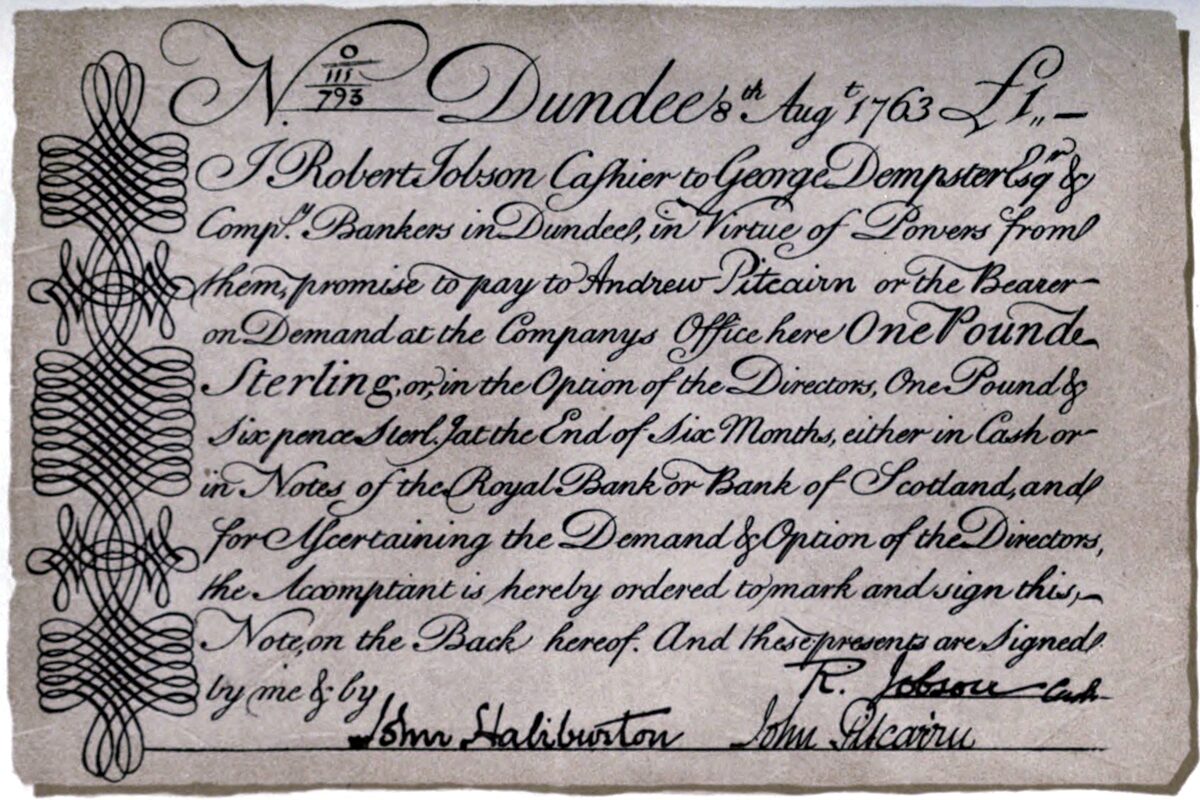
- 11 Scottish free banking 1716–1845
- 12 Ayr Bank, 1769–1772: Douglas, Heron & Co. fails and its partners pay its notes in full 1769–1773
- 13 British commercial copper tokens 1787–1797
- 14 Britain and Ireland, c. 1790–1828: mills and banks stamp their own value on Spanish dollars 1794–1828
- 15 Truck Act 1831: wages in coin, not goods 1831
- 16 England, 1844: the Bank Charter Act closes note issue to newcomers and freezes the country banks 1844
- 17 Lerwick, 1872: merchants' 'lines' passed as currency 1871–1872
- 18 Shetland, 1872: the truck system 1871–1872
- 19 Classical gold standard 1871–1914
- 20 Lombard Street, 1873: one bank holds the nation's gold reserve, and must lend freely in a panic 1873–1914
- 21 City of Glasgow Bank, 1878: unlimited calls on shareholders pay its creditors in full 1878–1882
Elsewhere
- a Britain and Ireland, c. 1790–1828: mills and banks stamp their own value on Spanish dollars Castlecomer
- b Warsaw, 1794: Kościuszko's treasury notes, secured on national land, forced on sellers Warsaw, 1794
- c Mandats territoriaux, 1796–1797: land notes forced as money, then released Paris, 1796
- Barbados paper credit of 1705-1706 Barbados, 1705
- Rhode Island, 1710-1764: bills of credit, the land 'banks' and silver at 8s to 27s an ounce Newport, 1710
- Specie Circular (1836): gold, silver or Virginia land scrip Washington, 1836
- Pennsylvania, 1723: the General Loan Office and its bills of credit Philadelphia, 1723
- Gold clauses, 1851–1896: contracts payable in coin, upheld against the greenback United States, 1851
Modern 1900 to today
4 entries, 1914–2026


The Loan, for which the lists were opened on the 17th November, was for £350,000,000 issued at 95, with a nominal interest rate of 3½%.Bank of England Archive M7/156, 'The Bank of England, 1914-1921', vol. I, ch. III 'War Loans' (typescript history written 1926), p. 385
What served as money share of 5 mentions
Hollow marks: entries elsewhere that its entries link to.
List of entries (4, and 1 elsewhere)
- 1 Britain's War Loans, 1914–1932: the Bank of England takes up the unsold 1914 loan; the 1932 conversion 1914–1932
- 2 Treasury appeal: notes instead of gold 1915
- 3 Britain: exchange control, 1947–79 1947–1979
- 4 United Kingdom: spending bitcoin is a taxable disposal 2021–2026
Elsewhere
- a Bretton Woods Mount Washington Hotel, 1944
What this cannot show
- How much money of each kind was in use: the marks count entries, not coins, notes or goods.
- A census: the atlas seeks out money made without a state, so an era with few entries is not an era with little money.
- The past's borders: entries are placed by today's, and the same money often ran beyond them; see the map.
Sources quoted on this page
- Mathisen, Barbarians, Hoards, and Hacksilver in Late Antiquity: The New Silver Monetary Zone on Rome's Northern Frontier, Chadwick Memorial Lecture 32 (Cambridge, 2024)
- The Anglo-Saxon Chronicle, trans. J. Ingram (1823) eBook #657
- G. C. Williamson, 'Historical evidence and information gathered from the traders' tokens of the seventeenth century and from the minor currency', Transactions of the Royal Historical Society 4 (1889) 171-196
- Bank of England Archive M7/156, 'The Bank of England, 1914-1921', vol. I, ch. III 'War Loans' (typescript history written 1926)