Money in China
中国的货币
Entries placed by today's borders.
Entries 58, in 4 eras
Span 1600 BC – 2026
Kinds of money Silver by weight 10, Chinese copper cash 7, Silk bolts 6, Chinese paper money 5, Zhou bronze forms 4, and 28 others
W ithin present-day China, the atlas places 58 entries, by their main place or a dated one, from 1600 BC to 2026. The oldest is Cowries in Shang China (1600 BC–1046 BC); the most recent, e-CNY: the digital deposit money phase (2026). The money named most often is Silver by weight, in 10 entries.
The word for money
- Chinese 錢 qián: an ancient field tool (a hoe/spade, 銚). Xu Shen, Shuowen Jiezi (c. 100 CE), juan 14 (金部), Wikisource, Shuowen 14 上, 金部 s.v. 錢 More on the word for money →
Antiquity 3000 BC – AD 499
11 entries, 1600 BC – 769


all denominations and soubriquets of the metallic cowries issued as currency c. COO B.C. in the state of Ts'u (Hupeh)Terrien de Lacouperie, A., Catalogue of Chinese Coins from the VIIth Cent. B.C. to A.D. 621... in the British Museum (1892), Introduction pp. xii, and glossary nos. 37-40
List of entries (11)
- 1 Cowries in Shang China 1600 BC–1046 BC
- 2 Zhou China: jade in ransoms, indemnities and the market 658 BC–526 BC
- 3 Spade money 650 BC–221 BC
- 4 Chu bronze cowries (ant-nose money) 600 BC–223 BC
- 5 Knife money 600 BC–221 BC
- 6 Split debt tallies (quan) in Warring States and early Han 300 BC–206 BC
- 7 Qin notched contract slips (jiaoquan) at Liye 222 BC–208 BC
- 8 Qin unifies the coinage 221 BC–207 BC
- 9 Wang Mang's shell and tortoise currencies AD 7–AD 23
- 10 Silk bolts as money at Turfan AD 273–769
- 11 Sogdian weighed silver AD 313–AD 314
Middle period 500–1499
28 entries, 574–1935
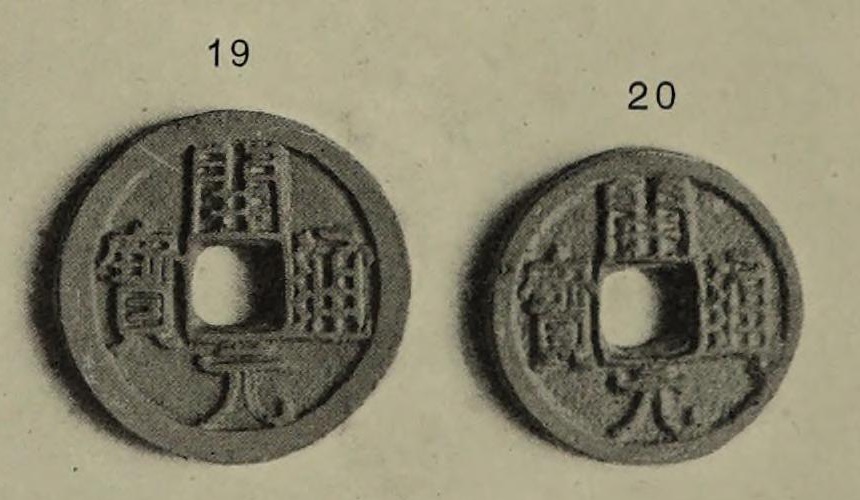


A continuing shortage of copper meant that government mints could not produce enough coins for the entire empire, to the extent that for most of the dynasty’s history, coins constituted only a tenth of the money supply.Hansen, V. & Wang, H., 'Introduction', Journal of the Royal Asiatic Society 23.2 (2013), pp. 155-156
Hollow marks: entries elsewhere that share this era's money (Chinese copper cash, Chinese paper money, Cowrie shells, Silk bolts) or that its sources name; the 4 farthest are listed below, not drawn.
List of entries (28, and 8 elsewhere)
- 1 Gaochang, c. 574-700: Sasanian silver coins as the oasis's money 574–700
- 2 Tang money: textiles, grain and coin 618–907
- 3 Xuanzang, c. 630: gold, silver and copper coins in the Tarim oases 629–630
- 4 Uighur horses for Tang silk 757–780
- 5 Khotan jade: tribute the Chinese court paid for 779–1799
- 6 Grain as money at Dunhuang 800–1000
- 7 Flying money (feiqian) 806–900
- 8 China, 851: copper the only current coin 851
- 9 China, 851: the state pays an honest bankrupt's creditors 851
- 10 Song bans copper cash leaving the empire 960–1234
- 11 Sichuan's iron cash: one copper for fourteen iron 965–1091
- 12 Song frontier markets with Liao, Xi Xia and Jin 977–1142
- 13 Tea bricks 1000–1935
- 14 Song silver and silk to Liao, Xi Xia and Jin 1004–1141
- 15 Jiaozi: first government paper money 1024–1120
- 16 Tea for horses on the Chinese frontier 1074–1435
- 17 Jin paper money (jiaochao), 1154–1233: notes first bought for travel, at last given up for silver 1154–1233
- 18 Huizi: Southern Song paper money 1160–1276
- 19 North China, 1230–31: taxes in silver, silk and grain (Yelü Chucai's ten circuits) 1230–1231
- 20 North China under Ögedei, 1230s–1240: 'lamb's interest' silver loans paid off by the treasury 1230–1240
- 21 Möngke's baoyin, 1255: a household tax in silver, half payable in silk and goods 1255–1260
- 22 Yuan paper money (chao) 1260–1356
- 23 Yunnan: cowries tied to silver 1280–1290
- 24 Zardandan: split tally sticks for debts 1280–1290
- 25 Salt money of Caindu (Marco Polo) 1280–1295
- 26 Da Ming Baochao 1375–1450
- 27 Ming China turns to silver 1375–1637
- 28 Ming horse markets: horses priced in silk and cloth 1403–1601
Elsewhere
- a Xuanzang, c. 630: gold, silver and copper coins in the Tarim oases Tukhara 630
- b Japan, 11th to mid-12th century: rice, silk and hemp cloth as money after the state stopped coining Heian-kyō, 1000
- c Rubruck, 1254: the paper money of Cathay Cathay, 1254
- d Japan on Chinese copper cash Japan, 1277
- Maldives cowrie export Malé, 851
- Gaikhatu's paper money at Tabriz, 1294 Tabriz, 1294
- Exchequer tally sticks Westminster, 1179
- Gao: buying and selling with cowries Gawgaw, 1353
Early modern 1500–1899
9 entries, 1567–1935


They are ready to trust and accommodate freely whoever they know treats them fairly, and does not fail in his payments to them when these are due.Antonio de Morga, Sucesos de las Islas Filipinas (Mexico, 1609), ch. VIII, transl. in E. H. Blair and J. A. Robertson (eds.), The Philippine Islands 1493-1898, vol. XVI (Cleveland, 1904), vol. XVI, ch. VIII
Hollow marks: entries elsewhere that share this era's money (Brick tea, Rupee) or that its sources name; the 3 farthest are listed below, not drawn.
List of entries (9, and 8 elsewhere)
- 1 Haicheng (Yuegang), 1567–1617: licences and silver duties on the Luzon trade 1567–1617
- 2 Manila, 1571–1815: Chinese silk for silver reals (today in China) 1571–1815
- 3 Nepal's silver coins as Tibet's money 1640–1792
- 4 Foochow (Fuzhou), c. 1800–1935: native banks' notes with no banking law 1800–1935
- 5 Tsaidam: priced in sheep 1845–1892
- 6 Silver against gold, 1871–1935: what silver money lost in India and China 1871–1935
- 7 Trade dollar, 1873–1878: a US silver coin made for China, bought at a premium over the Mexican dollar 1873–1878
- 8 Turfan and Aksu, 1886: Government of India notes at a discount 1886
- 9 Eastern Tibet, 1889: Indian rupees, not Chinese silver 1889
Elsewhere
- a Philippines, 1570s–1609: tribute of eight reals, paid in hens, rice and cloth Luzon, 1570
- b Mongolia: sheep, brick tea and squirrel skins as units of account Mongolia, 1870
- c Oman, 1895–1914: the Maria Theresa thaler, the rupee and imaginary coins Muscat, 1895
- d Jerm, 1838: the price of setting up house Jerm, 1838
- e Bhutan: debased 'Deb' rupees and taxes in kind Bhutan, 1838
- North-east Siberia: priced in roubles, paid in tea and tobacco Kamchatka, 1866
- Gold clauses, 1851–1896: contracts payable in coin, upheld against the greenback United States, 1851
- Nyassa territory, 1895–97: rupees and dollars banned, no coin sent Ibo and the Nyassa Company coast, 1895
Modern 1900 to today
10 entries, 1900–2026


Silver is most commonly current in oval ingots called f shoes " from their resemblance to a Chinese shoe ; but what may be called fractional currency is in obovoid lumps weighing up to two or three taels.H. B. Morse, The Trade and Administration of the Chinese Empire (London, 1908), p. 147
Hollow marks: entries elsewhere that share this era's money (Tsarist rouble notes); the 4 farthest are listed below, not drawn.
List of entries (10, and 7 elsewhere)
- 1 Western Tibet: a barter fair 1900
- 2 Sycee: silver "shoes" weighed and assayed, China, 1908–1926 1908–1926
- 3 North Manchuria: trade still in rouble notes, 1917–21 1917–1921
- 4 Hyperinflation: China (Yuan) 1943–1945
- 5 Hyperinflation: China (Yuan) 1947–1949
- 6 Online-game gold and real-money trading ('gold farming', incl. WoW gold) 2003–2012
- 7 China: the $50,000 yearly quota and capital controls 2007–2026
- 8 China: bitcoin restricted, then its business banned 2013–2026
- 9 e-CNY: the digital cash phase 2019–2025
- 10 e-CNY: the digital deposit money phase 2026
Elsewhere
- a Siberia, 1918–19: imperials hoarded, shop money and playing cards Vladivostok, 1918
- b Turkestan and Bukhara, 1920: Kerensky notes at a premium Tashkent, 1918
- c Urga, 1911–1913: debts to Chinese firms and a Chinese bank's notes after independence Urga, 1910
- Tsarist notes at a premium over Soviet notes, 1917–22 Soviet Russia, 1917
- Tsarist notes abroad: Berlin and the Baltic, 1918–20 Berlin, 1918
- Transcaucasia, 1918–24: three republic currencies, then one Transcaucasian rouble at 1 : 100 : 150 Tiflis, 1918
- Odessa, 1919: imperial notes at a premium Odessa, 1919
What this cannot show
- How much money of each kind was in use: the marks count entries, not coins, notes or goods.
- A census: the atlas seeks out money made without a state, so an era with few entries is not an era with little money.
- The past's borders: entries are placed by today's, and the same money often ran beyond them; see the map.
Sources quoted on this page
- Terrien de Lacouperie, A., Catalogue of Chinese Coins from the VIIth Cent. B.C. to A.D. 621... in the British Museum (1892), Introduction pp. xii, and glossary nos. 37-40
- Hansen, V. & Wang, H., 'Introduction', Journal of the Royal Asiatic Society 23.2 (2013), pp. 155-156
- Antonio de Morga, Sucesos de las Islas Filipinas (Mexico, 1609), ch. VIII, transl. in E. H. Blair and J. A. Robertson (eds.), The Philippine Islands 1493-1898, vol. XVI (Cleveland, 1904)
- H. B. Morse, The Trade and Administration of the Chinese Empire (London, 1908)